

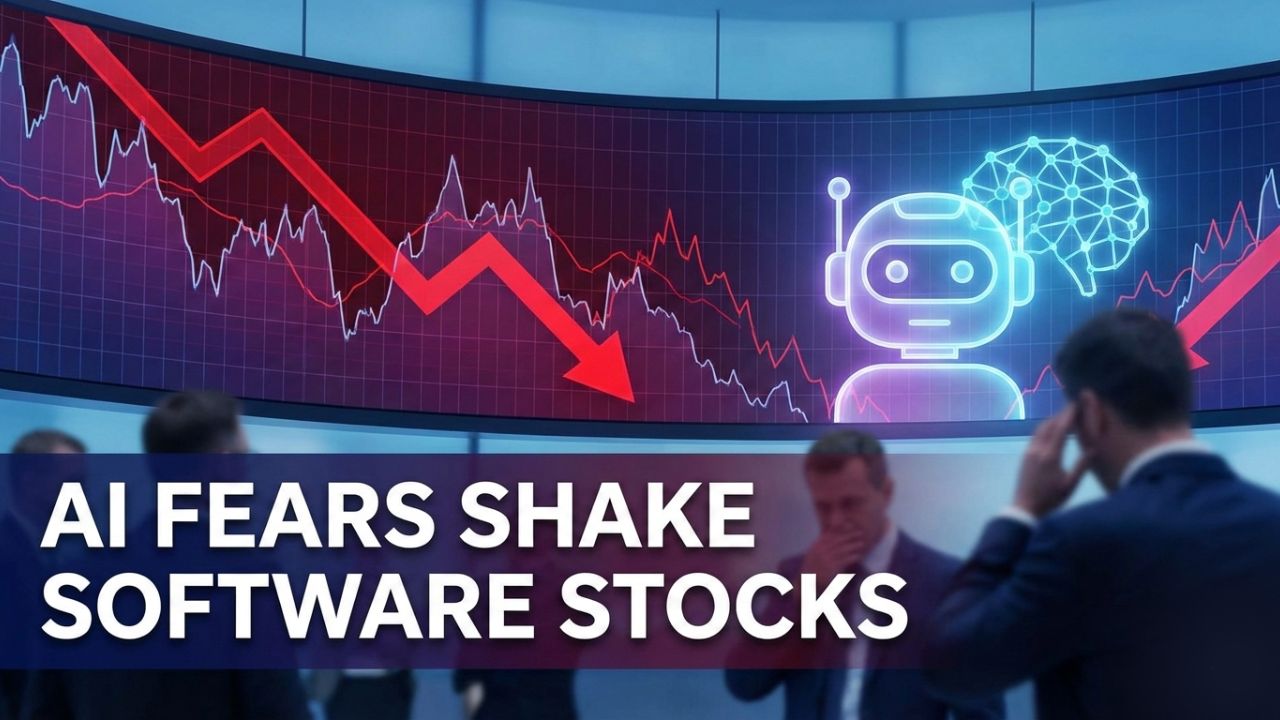
The stock markets of the global software companies are also feeling the heat since investors have now questioned the future of the sector in the era of fast AI uptake. Firms that were considered safe and long-term investments are increasingly coming under new suspicion.
The fear is around AI-native companies like Anthropic that are constructing powerful tools in-house. These platforms are competing with traditional software models in terms of cost, speed, and flexibility.
What makes this moment significant is the pace of change. AI capabilities are evolving faster than traditional enterprise software cycles, leaving little room for gradual adaptation.
This sell-off does not focus on short-term performance but on long-term relevance. Investors, businesses, and developers are all looking into the next place of value.
A Broad Market Pullback Fueled by Competitive Anxiety
It is the first year since 2022 that the software stocks have had the poorest opening year ever. The drop has been widespread, spanning enterprise software, cloud service, and SaaS vendors worldwide.
This move is associated with competitive fears, unlike the past downturns, which were influenced by interest rates or regulation. Investors are responding to the rate of transformation of fundamental software capabilities by AI tools.
Startups that are AI-native are providing cheaper and faster alternatives. This has led to a decrease in confidence in the pricing strength of the traditional software companies.
Even companies that were well-balanced have been drawn into the sell-off in certain instances. The interest is not in the monetary well-being but in the positioning down the line.
How AI Is Rewriting the Rules of Software Value
Software companies gained many years of high margins and consistent revenue through subscriptions. AI was not supposed to eliminate such benefits but enhance them.
Generative AI is no longer adding features. It is also replacing complete workflows that previously needed costly software licenses.
This questions whether contract, product differentiation, and legacy models can justify premium pricing in an AI marketplace.
How the value of software is measured is also challenged by the shift. The rate of innovation and flexibility is gaining importance, similar to scale and customer base.
A Sector-Wide Reset Across Companies, Users, and Talent
This change is being experienced throughout the software ecosystem. Critical questions around growth, pricing, and long-term relevance are becoming harder to answer for established software companies as AI-driven alternatives gain popularity.
Consumers, both businesses and individuals, are reconsidering software spending in light of cheaper and more adaptable AI tools. Meanwhile, developers are adjusting to evolving workflows as demand shifts to AI-first skills and platforms.
1. Traditional Software Models Face a New Stress Test
Investors and customers are putting increasingly close attention to large enterprise software vendors. The long-term contracts might be more difficult to justify since alternatives are being introduced.
Small SaaS companies are particularly vulnerable. Without scale or deep ecosystems, they risk being squeezed between AI startups on one side and larger incumbent players on the other.
There are companies that are retaliating by hastening the AI integration. Some are yet to establish the role of AI within their main services.
2. More Choice, Lower Costs, and Growing Uncertainty
To consumers, competition may lead to cheaper and more options. Advanced capabilities are also becoming accessible because of the AI tools.
But there is a possibility of instability due to rapid changes in products and the changing platforms. There is an open question regarding the long-term reliability.
Users may increasingly shift toward flexible tools rather than relying on all-in-one platforms. This may redefine the process of software loyalty.
3. Skills Priorities Shift Toward AI First Workflows
The trend in developers is towards AI-first and automation skills. The experience of model integration and AI tooling is gaining importance.
Instead of destroying jobs, AI is transforming the development work process and the value of skills.
Such a shift can be in favor of flexible teams and the existence of big, rigid development frameworks.
Investors Begin Drawing New Lines in the Software Space
This scene is a reflection of earlier technology corrections, only this time with a major twist. It is a disturbance created internally within the software industry.
The mood among investors is increasingly divided between AI-native businesses and what are now seen as legacy software companies. Flexibility has become a key test of valuation.
Markets are responding today due to the fact that the adoption of AI is visible and quantifiable. The change is no longer hypothetical, but it has already started to influence purchasing.
Markets Look for Proof, Not Promises
Shareholders are likely to focus on the quality of earnings, customer retention, and clear strategies for monetizing AI. There will be no more hype.
The question of whether AI startup economics is sustainable continues to be open. The rate at which already established software companies can adjust without damaging their revenue is also ambiguous.
Volatility in the short term could continue to exist as the market tries to identify absolute winners.
A Transition Period That Redefines Long-Term Software Success
The fall in software stocks is not an indication that the sector is over. Rather, it is an overview of the reconsideration of value in the face of a swiftly changing environment.
AI is pushing investors to reconsider long-standing assumptions about growth and stability. Certain models will develop, whereas others may fail.
This stage can be described as a transition and not a collapse. Software is necessary, but the principles that specify success are being redefined as we speak.











Leave a comment