

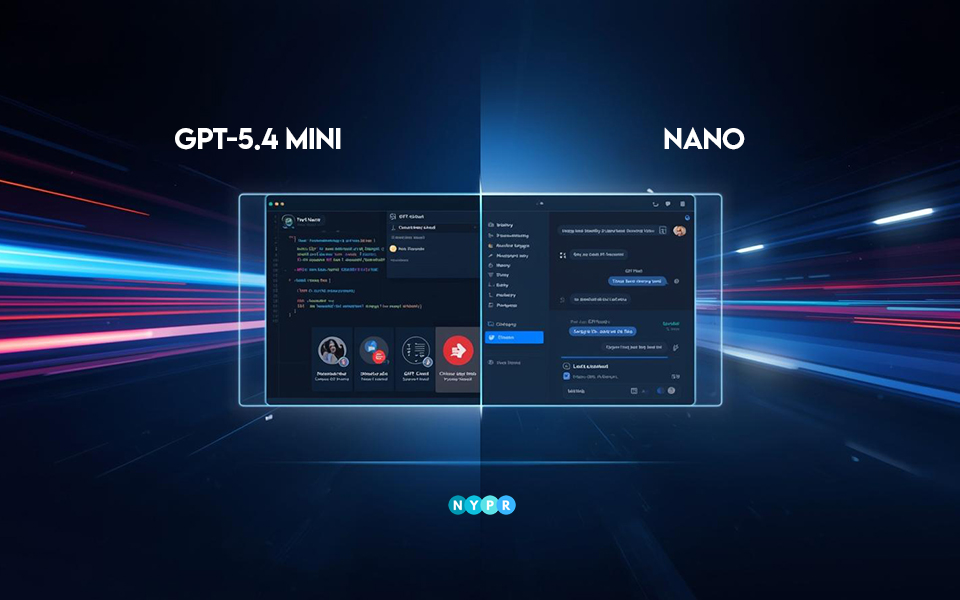
OpenAI has recently added two new AI models, namely GPT-5.4 mini and GPT-5.4 nano. These models are focused on speed, efficiency, and reduced cost. They are meant to be used in real-time and scalable programs.
The launch shows a wider move in favor of smaller and workable AI systems. All the developers, businesses, and common users are impacted. This update demonstrates that performance is no longer size-dependent.
A Closer Look at the Latest Release
The OpenAI company has released a new set of compact models aimed at improving performance without increasing cost or complexity.
“Today we’re releasing GPT-5.4 mini and nano, our most capable small models yet…”
These models build on earlier versions, including GPT-5 mini and nano. The improvements are noticeable in coding tasks, response speed, and handling real-world workflows.
In benchmark testing, GPT-5.4 mini shows stronger results on SWE-Bench Pro, which measures how well a model can solve software engineering problems. It also performs better on OSWorld-Verified, a benchmark focused on completing structured computer-based tasks.
GPT-5.4 nano, while smaller, still delivers consistent performance with faster response times. It is designed for lightweight applications where speed matters more than depth.
Together, these updates show how OpenAI models are evolving beyond raw scale. The focus is now on balance, performance, cost, and responsiveness.
Breaking Down the Core Improvements
A closer look at where these models stand out. From coding to system design, each area reflects a shift toward speed and practical use. These sections break down how the improvements translate into real-world impact.
1. Stronger, Faster Code Generation in Practice
GPT-5.4 mini shows clear gains in coding-related tasks. It handles debugging more effectively and produces cleaner outputs during iteration. Developers can move from idea to working code with fewer steps.
Front-end generation has also improved. The model can structure UI elements with better consistency, reducing the need for manual adjustments.
These changes make it a practical option for everyday development work, not just experimentation.
2. How Smaller Models Are Powering Larger Systems
A key shift is how AI systems are now structured. Instead of relying on one large model, many setups use a mix of models working together. Larger models handle planning, while smaller ones execute tasks. This is where the mini GPT approach becomes useful.
Mini and nano models can act as subagents, handling specific jobs quickly. This reduces overall system load and improves efficiency.
It also allows developers to build more flexible systems, where tasks are distributed based on complexity.
3. Beyond Text: Understanding Screens and Interfaces
The new models are designed to understand more than just text. They can interpret screenshots, analyze interface layouts, and follow on-screen instructions.
This is especially useful for tools that interact with software environments. For example, a model can guide actions within an app or assist with navigation tasks.
Improved UI understanding also supports automation. Systems can respond to visual inputs and make decisions based on what appears on screen.
4. Cost, Access, and What It Means for Adoption
Pricing is a key part of this launch.
- GPT-5.4 mini: $0.75 per million input tokens / $4.50 per million output tokens
- GPT-5.4 nano: $0.20 per million input tokens / $1.25 per million output tokens
These rates make both models more accessible for high-volume use. They are available through API access, as well as within tools like Codex and ChatGPT. This ensures that both individual developers and large teams can adopt them without major barriers.
Why This Shift Is Important Right Now?
The release highlights a clear trend: smaller models are becoming more capable.
For a long time, progress in AI was tied to building larger systems. That approach improved accuracy but also increased cost and latency. GPT-5.4 mini and nano take a different path. They aim to deliver strong performance while keeping response times low.
This matters in real-world use. Applications like coding tools, live chat systems, and interactive platforms need quick replies. Delays reduce usability. These models are also designed for multimodal environments, where systems process text, images, and interface elements together.
The shift suggests that bigger models are not always better. In many cases, smaller models provide a more practical solution.
Who Stands to Benefit Most?
The update applies to a very large audience of users, including those developing applications and those businesses looking to scale their operations. It also enhances the daily life of consumers, as tools on platforms are more responsive and quicker.
1. Faster Builds, Smarter Workflows
Developers gain advantages through their ability to work faster and their ability to spend less money on operating costs. The models allow developers to create new software versions at high speed, which simplifies their process of testing and improving program code.
The system operates effectively in subagent architectures, which distribute tasks between different models.
2. Scaling AI Without Scaling Costs
Businesses can scale AI systems more efficiently. Lower pricing reduces the cost of deploying AI across products and services. This makes it easier to integrate AI into customer support, operations, and internal tools.
3. Smoother, Faster Everyday Experiences
End users may not see the model names, but they will notice the difference. Applications become faster and more responsive. From mobile apps to web platforms, interactions feel smoother and more immediate.
What This Signals for the Future of AI?
The launch points to a broader direction for AI development. Smaller models are likely to play a larger role in the near future. Their ability to balance cost and performance makes them suitable for many real-world applications.
Developers are expected to adopt these models for faster, modular systems. Businesses may prioritize efficiency over raw capability.
At the same time, questions remain:
- How far can smaller models go without losing depth?
- Where is the balance between cost and capability?
These questions will shape how AI systems evolve in the coming years.
A Broader Look at Where AI Is Heading
The release of GPT-5.4 mini and nano demonstrates a continuous transformation in artificial intelligence development and application methods. The industry now prioritizes efficient use and flexible operational capacity instead of creating larger systems.
The change maintains its core elements, although the impact maintains its essential value to the system. The system development process will use new technologies that enable faster deployment and operation of systems that meet common user requirements.












Leave a comment