

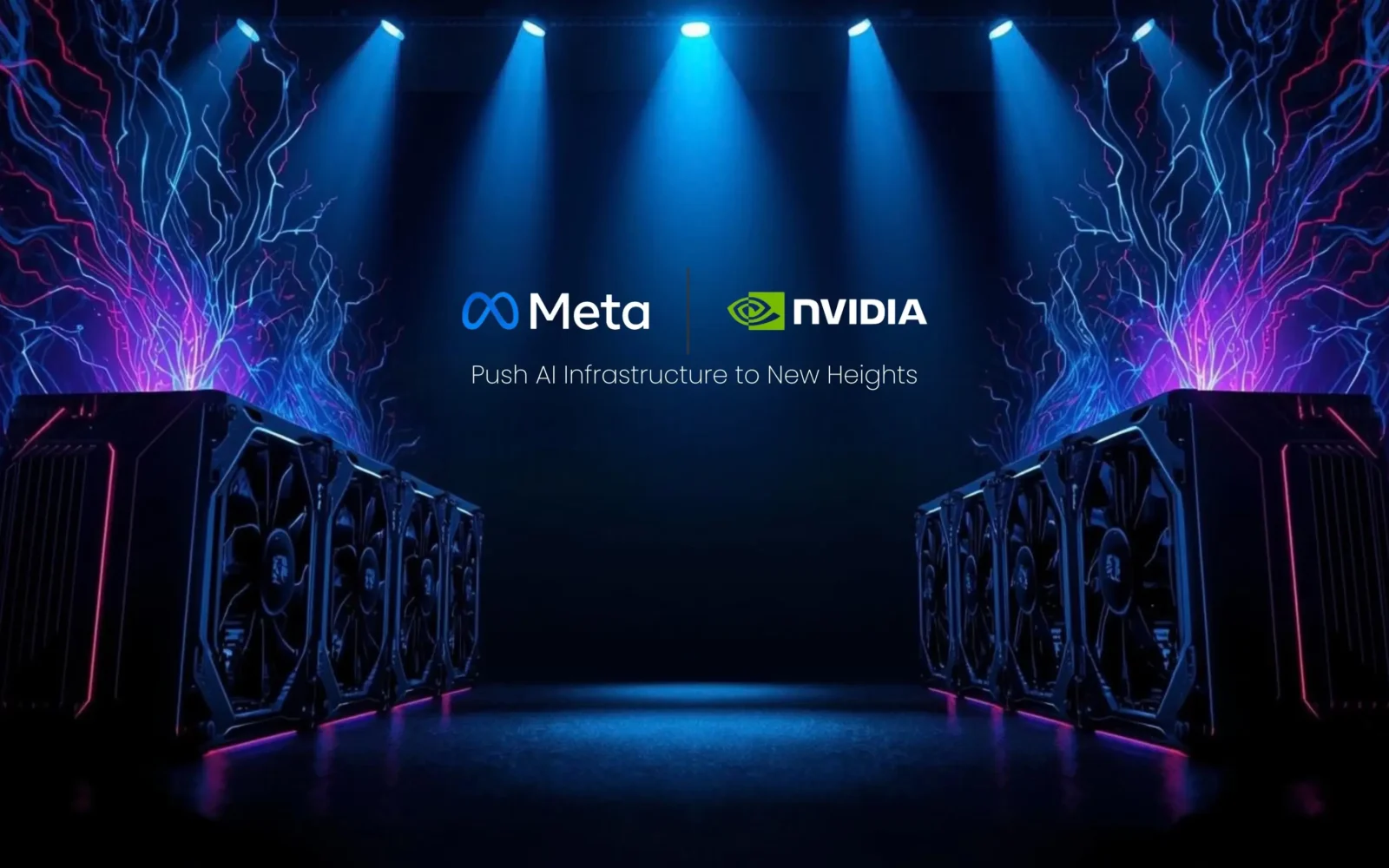
Meta is expanding its AI backbone with new systems from NVIDIA. The move centers on powerful Blackwell GPUs and the upcoming Vera Rubin platform. It reflects a race to build massive AI clusters that can train and run advanced models. Investors see it as a sign that spending on computing will keep rising.
The partnership affects businesses, developers, and billions of users worldwide. It also shows how NVIDIA AI is becoming core global infrastructure.
Building AI at Unprecedented Scale
Meta is deepening its partnership with NVIDIA to expand its global AI infrastructure. The company plans to deploy new clusters powered by NVIDIA’s Blackwell GPUs. It is also preparing to adopt the next-generation Vera Rubin platform in future systems.
The announcement, detailed in the NVIDIA Newsroom, shows how Meta is building computing power at a scale few companies can match. The goal is to train and run models that serve billions of users every day.
Jensen Huang, founder and CEO of NVIDIA, said:
“No one deploys AI at Meta’s scale — integrating frontier research with industrial-scale infrastructure to power the world’s largest personalization and recommendation systems for billions of users,”
Mark Zuckerberg, founder and CEO of Meta, said:
“We’re excited to expand our partnership with NVIDIA to build leading-edge clusters using their Vera Rubin platform to deliver personal superintelligence to everyone in the world,”
Understanding the New AI Core
Blackwell chips are NVIDIA’s latest generation of AI processors. They are designed for heavy workloads such as training large language models and running complex inference systems. Compared to earlier chips, they offer higher performance and better energy efficiency.
The Vera Rubin platform represents NVIDIA’s next step after Blackwell. It combines new GPU designs with advanced memory and networking systems. The aim is to build faster, more efficient AI clusters.
An AI cluster is a network of thousands, or even hundreds of thousands, of GPUs working together. Instead of a single computer training a model, the work is split across many machines. This allows companies to build bigger models and deliver faster responses.
As companies using AI at a global scale grow, these clusters become critical. They power recommendation engines, chatbots, image generators, and business tools.
Meta’s systems rely heavily on NVIDIA products to handle this workload. The scale of these deployments reflects ongoing NVIDIA AI advancements across hardware and software. It also shows how NVIDIA products are now central to modern data centers.
The Infrastructure Race Behind the AI Boom
AI is no longer just about models. It is about the hardware and software that run them. NVIDIA has emerged as the dominant force among AI infrastructure companies. Its chips power most of the world’s major AI data centers. Cloud providers, startups, and large tech firms all depend on NVIDIA AI systems.
The investment by Meta points to a larger trend. Big tech companies are paying billions of dollars for compute capacity. Their view of AI is not a short-term functionality but a long-term platform.
Investors are watching this closely. Market reaction to NVIDIA’s announcements often reflects expectations of continued AI spending. Strong demand for chips signals that companies plan to keep expanding data centers.
One reason for NVIDIA’s position is its integrated stack. The company does not just sell hardware. It also provides NVIDIA software that helps developers train and deploy models.
This includes frameworks, libraries, and tools that simplify complex tasks. Together with its chips, this creates a full ecosystem. Many companies rely on this combination of hardware, software, and NVIDIA support.
That support ecosystem includes developer tools, networking technology, and system design expertise. It makes it easier for companies to build and scale AI clusters.
As AI capabilities expand, the need for this integrated approach grows. Training larger models requires more power, more memory, and faster networking. NVIDIA’s strategy is to provide all of it as a unified platform.
This is why the competition among AI infrastructure companies is so intense. Control over the compute layer means influence over the entire AI ecosystem.
Ripple Effects Across the Digital Economy
Meta’s infrastructure push will be felt far beyond its own apps. Stronger AI systems powered by NVIDIA will shape advertising, cloud services, developer tools, and everyday digital experiences. As more companies build on this compute layer, the effects will spread across the entire digital economy.
A. How Industry Will Use the New Power
Companies that depend on advertising, analytics, or automation will feel the impact first. Meta’s platforms use AI to match ads, analyze trends, and automate workflows.
Stronger NVIDIA AI systems mean faster model training and better predictions. That can lead to more accurate targeting and new AI-powered enterprise tools.
Cloud services also benefit. As Meta and other companies build larger clusters, the entire ecosystem of services built on NVIDIA products expands.
B. A Stronger Platform for Creators
Developers gain access to more powerful models and infrastructure. This makes it easier to build applications using AI without managing complex hardware.
NVIDIA’s stack includes widely used NVIDIA software frameworks. These tools help developers train, optimize, and deploy models across different environments.
Better infrastructure also means faster experimentation. Developers can test ideas quickly and scale successful ones without rebuilding systems from scratch.
The company’s global NVIDIA support network plays a role here. It provides documentation, tools, and technical assistance that reduce friction.
C. How Daily Digital Life Will Evolve
For everyday users, the effects appear in subtle ways. Feeds become more relevant. Search results feel more accurate.
Voice assistants, chatbots, and translation tools improve as AI capabilities grow. The experience becomes faster and more personal.
These improvements come from companies using AI at scale. Behind the scenes, they rely on massive clusters powered by NVIDIA AI.
From Infrastructure to Everyday Intelligence
The rollout of Blackwell systems is just beginning. Data centers around the world are preparing to deploy them. The Vera Rubin platform will follow. It is expected to push performance even further.
This expansion will require new facilities, more power, and improved cooling systems. AI data centers already consume large amounts of electricity. Future clusters may demand even more.
Cost is another factor. Building and running these systems requires billions of dollars. Only the largest companies can afford this level of investment.
Regulators are also paying attention. As AI systems grow more powerful, questions around safety, privacy, and accountability become more urgent.
Meta’s vision of “personal superintelligence” is ambitious. It suggests AI that can assist individuals in everyday decisions and tasks. Whether that becomes reality will depend on both technical progress and public trust. Still, the direction is clear. As AI capabilities improve, infrastructure becomes the foundation.
AI Becomes Industrial Infrastructure
This partnership is about more than a hardware deal. It signals a shift in how AI is built and deployed.
NVIDIA’s products are becoming the backbone of modern computing. Data centers built on NVIDIA products now power everything from search engines to recommendation systems.
The rise of AI infrastructure companies shows that the real battle is happening behind the scenes. Whoever controls the compute layer shapes the future of AI.
What once lived in research labs is now running at an industrial scale. AI is no longer an experiment. It is becoming part of the global technology infrastructure.











Leave a comment