

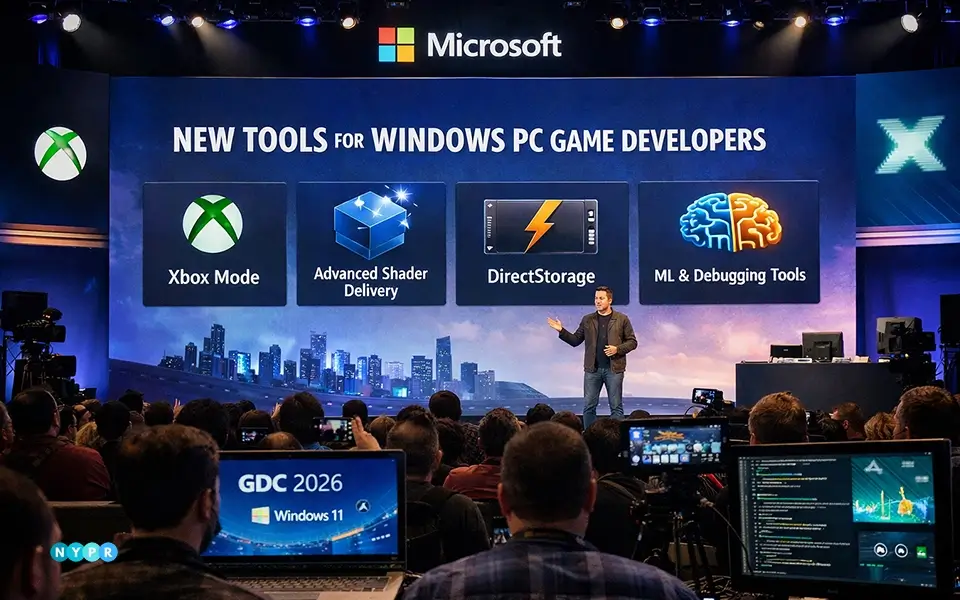
In 2026, Microsoft unveiled a set of platform enhancements and developer resources to improve the development of PC games on Windows. The messages are centered on enhancing performance, removing technical bottlenecks, and increasing development potential within the ecosystem.
The company unveiled new platform capabilities of Windows 11 PCs, graphics technology, and developer debuggers. All these transformations will work together to provide faster load times, more refined gameplay, and a platform on which graphics are being improved using machine learning.
For developers and studios, the updates are viable modifications to the way PC games are constructed, optimized, and released.
Xbox Mode Set to Arrive Across Windows 11 PCs
The opening up of Xbox Mode to all Windows form factors was one of the largest announcements. The feature will also be extended to laptops, desktops, and tablets running Windows 11, whereas previously it was only available on a select number of devices. The implementation will start in April.
Xbox Mode is an interface that makes the controller gaming-friendly. Once it is turned on, it puts the system into a full-screen environment that resembles a console dashboard. Games will allow players to browse their game library, start titles, and go to the Game Bar, all through this interface.
It can also be designed to enable the user to access the desktop quickly. This simplifies the transition between gaming and traditional PC tasks for players. To developers, the feature provides a more unified interface across different hardware platforms.
Advanced Shader Delivery Aims to Reduce Gameplay Stutter
Another major announcement focuses on one of the most common performance issues in PC gaming: shader stutter. Microsoft introduced a new system called Advanced Shader Delivery (ASD). The technology allows shaders to be prepared and delivered in a way that reduces delays during gameplay.
Shader compilation can often occur during gameplay, leading to frame drops. ASD aims to reduce this by allowing shaders to be prepared earlier in the process. Developers can enable the feature themselves using APIs provided through the DirectX Agility SDK.
Once prepared, shader packages can be uploaded through the Xbox Partner Center. Games can then retrieve them during installation or startup. The goal is faster startup times and smoother gameplay experiences. Third-party developer testing is expected to begin in May.
The technology was first introduced with the ROG Xbox Ally handheld device and is now expanding across the PC ecosystem.
DirectStorage Updates Improve Asset Streaming and Load Times
Microsoft also introduced improvements to DirectStorage, the technology designed to speed up asset loading in games. One key addition is support for Zstandard compression. This compression method allows game assets to remain compact while still loading quickly.
Alongside that, Microsoft introduced a new Game Asset Conditioning Library. This tool helps developers prepare assets so they can be streamed efficiently during gameplay. The result is better compression efficiency and faster asset delivery to the GPU.
These changes reduce I/O latency and make better use of modern NVMe storage hardware. For developers building large open worlds, the improvements make it easier to stream massive environments without loading interruptions. Faster asset streaming also supports smoother transitions between game areas.
DirectX Introduces Machine Learning Capabilities for Graphics
Microsoft also outlined how DirectX is evolving to support machine learning workloads in graphics pipelines. The company added linear algebra support to HLSL, the High Level Shader Language used by DirectX.
This enables hardware-accelerated machine learning operations directly within shaders. A preview version of Windows ML for graphics workloads is also being introduced. This allows developers to integrate custom machine learning models into gameplay or rendering.
Possible uses include intelligent image upscaling, advanced lighting techniques, and improved animation systems. These capabilities are designed to work across modern GPUs, allowing developers to experiment with ML-driven rendering techniques.
New Diagnostic Tools Arrive for Graphics Development
To support developers working with increasingly complex graphics systems, Microsoft announced several new debugging tools. One of the most notable is DirectX Dump Files. This feature captures GPU crash data and graphics pipeline state at the moment of failure.
Developers can use the captured data to analyze what caused the crash. Another addition is DebugBreak() support in HLSL. This introduces shader-level breakpoints, allowing developers to pause execution during debugging.
Microsoft also revealed a new Shader Explorer tool. It allows developers to inspect compiled shader code more easily. Updates are also coming to the PIX performance analysis tool. These improvements include a Tile Mappings Viewer and access to hardware-specific GPU counters. A preview of these debugging tools is expected to arrive in May 2026.
How These Updates Shape the Future of PC Game Development
The announcements reflect a broader effort to improve the development pipeline for modern PC games. Loading speeds remain one of the most visible issues for players. DirectStorage improvements address this by allowing faster asset streaming from storage devices.
Shader stutter is another common complaint. Advanced Shader Delivery aims to reduce that problem by ensuring shaders are prepared earlier. Machine learning features in DirectX represent a longer-term shift in graphics technology.
As hardware becomes more capable, developers are beginning to explore ML-driven rendering techniques. These could reshape how lighting, animation, and image scaling work in future games. Taken together, the changes support more efficient development workflows. They also strengthen the foundation for Windows 11 pc gaming, which continues to serve as a central platform for many game studios.
Where the Impact Will Be Felt?
These updates affect multiple parts of the gaming ecosystem. Developers gain better tools and performance improvements, while studios benefit from more efficient production workflows.
For players, the changes are expected to translate into smoother gameplay, faster loading, and a more consistent gaming experience on PC.
A. For Game Developers
Developers will likely see the most immediate benefits. New debugging tools reduce the time needed to track down GPU crashes or shader problems.
Advanced Shader Delivery also gives developers more control over how shaders are compiled and distributed. Combined with DirectStorage improvements, these tools simplify optimization for modern hardware.
B. For Game Studios and Publishers
Large studios working on complex projects benefit from improvements in asset streaming and performance diagnostics. Games with large open environments or high visual fidelity often face storage and shader challenges.
The new toolset can help reduce those issues during production. It also supports a more predictable development process across different PC configurations.
C. For PC Gamers
For players, the changes translate into more consistent performance. Faster loading times, fewer shader-related frame drops, and smoother transitions between game environments are the most noticeable effects.
Xbox Mode may also make PC gaming more accessible for players who prefer a controller-first experience.
What This Signals for the Wider Gaming Ecosystem?
Microsoft used the conference to reinforce its long-term approach to PC gaming. The company emphasized collaboration across the hardware ecosystem, including partnerships with AMD, Intel, NVIDIA, and Qualcomm.
Microsoft summarized its strategy in a statement shared during the event:
“Our focus is clear: making Windows 11 the best place for game developers to create, experiment, ship, and scale. Windows is an open, flexible platform that supports choice across engines, tools, hardware, and distribution models. That commitment is rooted in close collaboration across our ecosystem, including partners like AMD, Intel, NVIDIA, and Qualcomm, and strengthening our deep partnership with Xbox, driving innovation to shape the future of gaming with the development community.”
The message highlights the company’s effort to position Windows as a central platform within the broader gaming ecosystem. These Microsoft updates also show a continued push toward deeper integration between PC gaming and the Xbox platform.
What Comes Next for Developers and Players?
Several of the newly announced features will begin rolling out soon. Xbox Mode expansion is scheduled to start in April across Windows 11 devices.
Advanced Shader Delivery will enter third-party developer testing in May. The new DirectX debugging tools and PIX updates are also expected to arrive in preview form around the same time.
Machine learning features within DirectX will continue evolving as developers experiment with the new capabilities.
Looking Ahead for PC Game
The announcements at GDC 2026 highlight how PC game development continues to evolve alongside hardware and graphics technology.
By introducing new tools, performance improvements, and machine learning capabilities, Microsoft is working to strengthen the foundation developers rely on when building games for the Windows platform.
As these updates begin rolling out throughout the year, developers will start exploring how the changes shape the next generation of PC games.













Leave a comment