

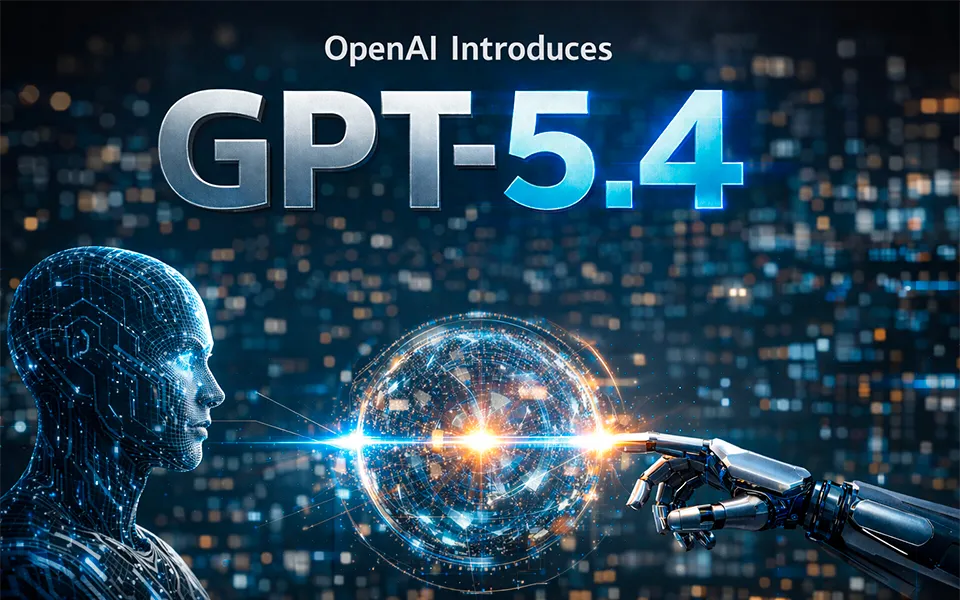
A new milestone has arrived in the rapidly evolving AI industry. OpenAI launches GPT-5.4, introducing a model designed to reason more effectively, manage longer tasks, and interact directly with software and websites.
The update introduces two major system versions, including a more advanced reasoning mode and a higher-performance professional tier. Both are built to support complex workflows and more capable AI agents.
The release is significant because it advances AI beyond simply answering questions. Instead, the technology is increasingly able to plan tasks, operate tools, and complete work across digital environments.
For developers, businesses, and everyday users, the update signals a shift toward AI systems that behave less like chatbots and more like intelligent assistants.
How GPT-5.4 Redefines AI Reasoning?
The newest generation of AI from the OpenAI company focuses heavily on reasoning. One of the most noticeable changes appears in the system’s “Thinking” mode. When users activate GPT-5.4 Thinking inside ChatGPT, the model can present an upfront plan describing how it intends to approach a question or task.
This planning step allows users to guide the response before the model finishes generating it. In practical terms, that means someone researching a topic or planning a project can adjust the direction while the answer is still forming.
The approach reflects a broader shift in how advanced OpenAI models are being designed. Instead of producing instant answers, the system works through a structured reasoning process. The model is also better at maintaining context during longer tasks. GPT-5.4 supports up to 1 million tokens of context, allowing it to remember far more information during conversations and multi-step workflows.
For researchers and developers, that extended context window opens the door to complex analysis, large document reviews, and longer collaborative sessions with AI. Another improvement focuses on deep web research. The model is better at synthesizing information across multiple sources and maintaining coherence during lengthy reasoning tasks.
These changes suggest that AI is increasingly moving toward sustained problem-solving rather than quick question-and-answer interactions.
From Chatbot to Digital Operator
One of the most significant upgrades in GPT-5.4 is its ability to operate computers directly. The system introduces native computer-use capabilities, allowing AI agents to interact with software interfaces, browse websites, and execute actions across applications.
Instead of simply describing how to complete a task, the model can perform parts of the task itself. For example, GPT-5.4 can write code that controls computers through tools like Playwright. It can also perform keyboard or mouse actions using screenshots of a user’s screen.
This enables automated workflows such as filling out forms, navigating dashboards, or interacting with web applications. Benchmarks highlight how much progress has been made in this area.
The model achieved a 75.0% success rate on OSWorld-Verified, outperforming previous versions and even surpassing the human baseline for that benchmark. It also reached 67.3% success on WebArena-Verified and 92.8% on Online-Mind2Web, both tests designed to measure how effectively AI can navigate real web environments.
These numbers suggest that AI agents are becoming more reliable when performing digital tasks independently. For businesses experimenting with automation, that capability could significantly expand how AI is used in daily workflows.
How AI Learns to Find the Right Tools?
Another change focuses on how AI systems interact with external tools. GPT-5.4 introduces a feature known as Tool Search. Instead of loading every available tool into a prompt, the system can dynamically locate and use the tools it needs during a task.
This approach reduces the amount of information the model must process at once. In internal testing, tool search reduced token usage by 47%, while maintaining the same level of task accuracy.
The improvement is important for developers building AI agents that interact with multiple services or APIs. It also enables more flexible systems that can adapt to new tools without needing constant prompt updates.
In practical terms, AI agents can now discover and select tools in a way that resembles how humans search for resources while solving problems.
AI Moves Deeper Into Professional Work
Beyond automation and reasoning, GPT-5.4 also targets professional productivity. OpenAI evaluated the system using a benchmark known as GDPval. The test compares AI performance against professionals across a wide range of occupations.
Results show that GPT-5.4 matched or exceeded human performance in 83% of comparisons across 44 occupations. These roles include fields such as research, analysis, and other knowledge-based tasks.
The model also demonstrated strong web research capabilities. The GPT-5.4 pro Model achieved 89.3% on BrowseComp, a benchmark designed to measure agentic web search performance. That level of accuracy suggests the system can perform more complex information gathering without constant human guidance.
For organizations relying on research, data analysis, or documentation, these improvements may significantly increase productivity.
A New Boost for Developers and Software Teams
Developers are another major focus of the GPT-5.4 release. The model improves coding performance while reducing response latency. In internal testing, it matched or outperformed GPT-5.3 Codex on SWE-Bench Pro, a benchmark that evaluates software engineering tasks.
The result suggests that the system can handle more complex coding challenges while delivering faster responses. Developers also gain more control over how the AI behaves.
Through developer messages, teams can guide the model’s behavior and configure safety policies. This allows organizations to customize how AI operates within their applications.
Combined with the new computer-use capabilities, the update could significantly expand how developers integrate AI into software workflows.
Building Safer and More Transparent AI Systems
As AI systems gain new capabilities, safety concerns become more important. The company says GPT-5.4 includes a stronger safety architecture designed to manage emerging risks.
One part of this approach involves cyber capability classification, a system used to evaluate the model’s ability to perform tasks that could have security implications. The company also introduced enhanced monitoring systems that track how the model behaves during complex reasoning processes.
Researchers are exploring chain-of-thought monitorability, which studies how reasoning steps can be observed and evaluated for safety. The goal is to ensure that increasingly capable AI systems remain transparent and accountable.
While these measures are still evolving, they reflect growing industry attention to responsible AI deployment.
Who Gets GPT-5.4 and When?
GPT-5.4 is already being rolled out on a number of products. GPT-5.4 Thinking is replacing GPT-5.2 Thinking Plus, Team, and Pro.
On June 5, 2026, the older GPT-5.2 Thinking model will be retired. In the meantime, the more advanced version can be obtained using Pro and Enterprise plans.
The model is also accessible to developers via the API, with updated pricing and enhanced efficiency of tokens. Such changes will ensure the system becomes more practical to both personal users and to larger organizations operating AI-based services.
A Turning Point for Intelligent AI Assistants
The introduction of GPT-5.4 is indicative of a larger change in the AI industry. The initial AI solutions were text-generating. The following generation is meant to think, think, and act.
As context windows are increased, there is more justification in reasoning and the capability to communicate directly with software; AI agents are becoming more competent to manage intricate workflows.
In the case of businesses, it might involve AI systems processing research, driving digital tools, and supporting professional work in ways that were not previously feasible a few years ago. It also brings new questions regarding the collaboration between humans and AI in the work environment.
Why GPT-5.4 Signals the Next Phase of AI?
The GPT-5.4 release is another step towards the development of AI systems that act as active digital assistants, but not passive chat interfaces.
With advances in reasoning and computer use, the update indicates a future in which AI agents can plan their tasks, browse software, and assist with complex work.
For the technology industry, the announcement reflects a growing focus on building AI that can act, not just answer.











Leave a comment