

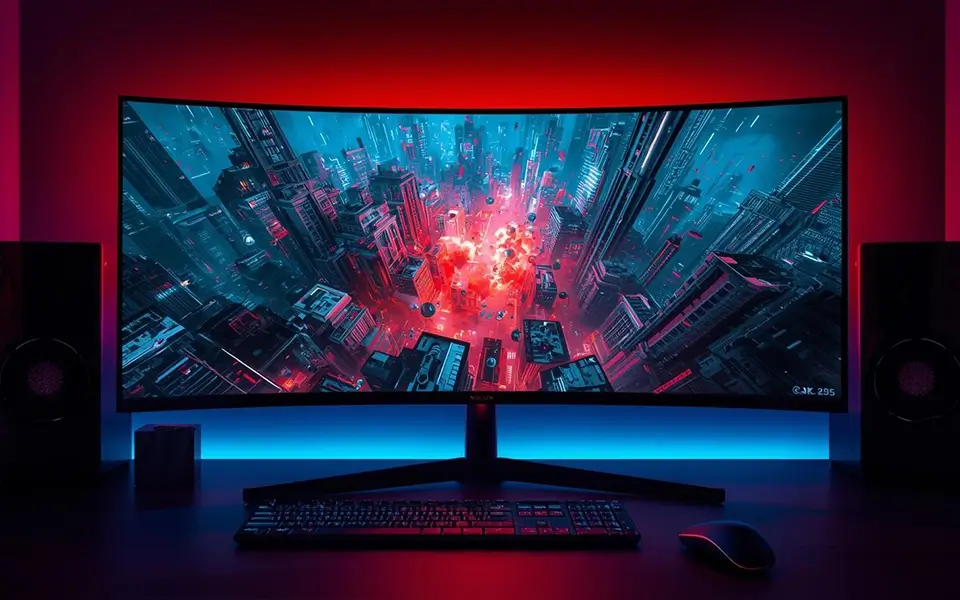
Samsung Electronics has launched its Odyssey series of gaming monitors, which includes five new models with various new industry standards. It was announced before the CES 2026 trade show.
This launch represents a strategic expansion of the high-end gaming monitor category. Rather than focusing on a single metric, Samsung is advancing on multiple fronts simultaneously: spatial depth with glasses-free 3D, pixel density with 5K and 6K resolutions, and motion clarity with extreme refresh rates. This approach offers different pathways to immersion for various user preferences and pushes the entire display market forward.
The new products target unique categories of the gaming and creator market with specialized models. It directly affects high-end gamers, competitive esports players, content creators, and the broader PC hardware ecosystem.
What Samsung Introduced Ahead of CES 2026
Samsung announced five new Odyssey gaming monitor models ahead of CES 2026. The timing coincides with CES 2026, the premier stage for unveiling future technology.
The lineup consists of three distinct model series. The Odyssey 3D G90XH features its debut, which Samsung describes as the first 6K glasses-free 3D gaming monitor on the planet. It is a 32-inch display using a 6K (6,144 x 3,456) IPS display. The real-time eye-tracking technology makes its glasses-free 3D work possible and provides the depth and perspective adjustment according to the viewer’s position. In terms of performance, it has a 165Hz native refresh rate, but can be increased to 330Hz with a Dual Mode with lower resolutions.
The release provides updated Odyssey G6 and G8 models. The Odyssey G6 (G60H) is a 27-inch monitor with a QHD screen in the competitive esports market. The most impressive feature is that it has a refresh rate of up to 1,040Hz in dedicated HD Dual Mode, which is considered a world first by Samsung. It has native QHD resolution, which has a 600Hz refresh rate. The monitor is also equipped with AMD FreeSync Premium support, and it is listed as NVIDIA G-Sync Compatible.
Odyssey G8 has now become three models with the option of peak resolution and high-quality contrast. This will consist of a 32-inch 6K product (G80HS), a 27-inch 5K product (G80HF), and a 32-inch 4K QD-OLED product (G80SH). The OLED model comes with a glare-free coating and is VESA DisplayHDR True black 500 certified, which serves users who are more concerned with visual accuracy in the cinema.
In the official announcement, Hun Lee, who is the Executive Vice President of Samsung Visual Display Business, said that this was the intention of the company with this release. He gave the following declaration:
“With this year’s Odyssey lineup, we’re introducing display experiences that simply weren’t possible even a year ago. We focused on meeting the demands of modern gamers and creators by delivering a new level of immersion that changes how content functions on screen.”
Why This Launch Matters for Samsung’s Market Strategy
This multi-front advancement signals that the high-end monitor market is diverging into specialized tracks instead of a linear progression. Samsung is investing in both proven trajectories (higher resolution, higher refresh rates) and speculative, experience-driven technology (glasses-free 3D).
The business background of this launch is that Samsung has a strong reputation in the high-refresh-rate monitors market. The firm quotes statistics by IDC that show that it has 18.8% of the revenue worldwide in the gaming monitors with a refresh rate of more than 144Hz. This launch is a direct move to solidify and expand that leadership by setting new benchmarks before competitors can catch up to current standards.
The practical adoption of the glasses-free 3D technology will depend heavily on software integration. Samsung notes collaborations with game studios to optimize effects for specific titles, including The First Berserker: Khazan and Stellar Blade. The success of this feature will be determined by the breadth of this support over time. This approach indicates a strategic push to avoid the pitfalls of past 3D initiatives by securing early content support, making its ecosystem strategy as important as its hardware innovation.
How the Odyssey Lineup Affects the Wider Ecosystem
Businesses:PC Hardware Manufacturers, as these monitors will require powerful new hardware to drive them, influencing demand for next-generation GPUs. The ecosystem for high-performance computing is directly impacted.
Consumers: The target audience is segmented into specific groups. The Immersion Chasers are high-end gamers seeking the cutting edge, whether through spatial 3D effects, ultra-high refresh rates for competitive play, or the perfect contrast of OLED for cinematic experiences. The Pixel-Perfect Professionals are content creators served by the 5K, 6K, and OLED models with high visual accuracy for users who are more concerned with visual accuracy in the cinema and production. The Frame-Rate Warriors are competitive Esports Players directly targeted by the Odyssey G6 model and its extreme 1,040Hz capability, where motion clarity is paramount.
Developers:Game studios and software developers are critically affected. The practical adoption and success of the glasses-free 3D technology are contingent upon their optimization efforts. Samsung’s cited collaborations are just the beginning, and broader developer buy-in is essential for the technology to move from a niche novelty to a supported standard.
From CES Demo to Commercial Reality
The products will be available for hands-on experience at CES 2026 in Las Vegas from January 6-9. This is the immediate next step for industry and press evaluation.
Major questions surrounding the lineup remain unanswered in this initial announcement. Samsung has not provided pricing information or a detailed global availability schedule. The final market impact will be influenced by these factors, as well as the real-world performance of the new 3D technology and the required hardware to drive these high-resolution, high-refresh-rate displays.
The coming months will focus on the revelation of these commercial details. Furthermore, the industry will watch for announcements of additional software partnerships and developer tools aimed at broadening support for the 3D display technology beyond the initially named titles.
Samsung’s Odyssey launch is a bold portfolio play that attempts to simultaneously capture and create demand across the zenith of the monitor market. It reflects a confidence to lead rather than follow.
However, its success is fragmented across each segment. The high-refresh-rate and OLED models compete in established, if premium, categories where performance can be readily measured and valued. In contrast, the 6K 3D monitor is a more visionary bet, seeking to resurrect and reinvent a historically challenging technology.
Its fate depends less on Samsung’s hardware engineering, which appears formidable and more on the unpredictable elements of developer adoption, content support, and ultimately, whether a significant user base finds the 3D experience compelling enough to justify what will inevitably be a substantial cost.
The coming months, post-CES, will be defined by the revelation of those missing price and availability details, which will separate this launch’s revolutionary potential from its commercial reality. The launch successfully sets a new high-water mark for ambition in the display sector, but its legacy will be determined by market readiness and consumer acceptance of its most radical propositions.










Leave a comment