

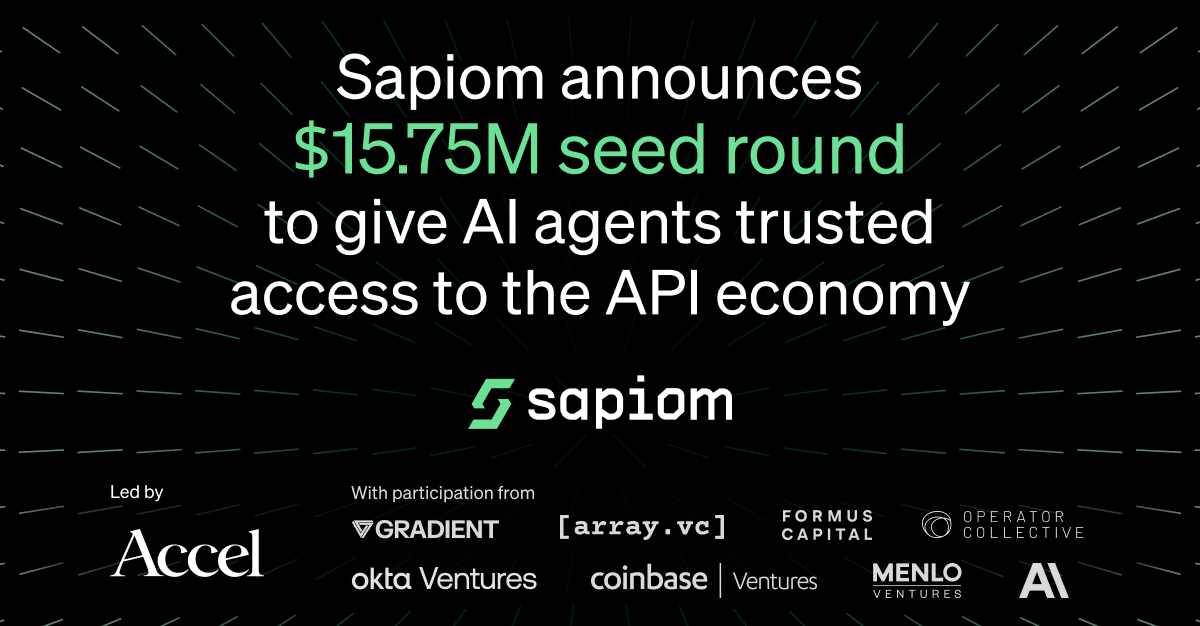
Startup Sapiom has raised $15.75 million in seed funding to build payment and identity infrastructure for AI agents. The company wants to make it easier for software agents to access APIs, compute, and other online services without human intervention. The round was led by Accel with backing from several tech and venture firms.
The funding highlights a growing problem in the AI economy: agents can perform complex tasks, but they still rely on humans to handle payments and authentication. Sapiom is trying to remove that barrier.
If the approach works, it could change how AI systems interact with software, APIs, and online services. It may also shape how businesses design tools for autonomous agents in the coming years.
A Funding Round Focused on Agent Infrastructure
Sapiom announced a seed round of 15.75 million led by Accel. Investors like Gradient, Okta Ventures, Array Ventures, Menlo Ventures, Anthropic, and Coinbase Ventures were also part of the round. There were also strategic angels of such companies as Shopify, OpenAI, and GitHub.
The startup is developing the infrastructure where AI agents can pay and use digital services independently. That covers such things as APIs, cloud servers, data tools, and messaging platforms.
In the current world, the majority of online systems are human-centric. A person creates an account, provides the payment information, and handles credentials. An AI agent can possibly write code or design workflows, but the agent still requires a human to do this.
Sapiom’s platform aims to handle identity, wallets, policies, billing, and risk controls in a single integration. The idea is to let software spend money under defined rules, much like it would call any other function.
The company was founded by Ilan Zerbib, a former payments engineering leader at Shopify. He saw the problem while working on payment infrastructure and launched Sapiom to focus on enterprise use cases.
The Missing Layer in the AI Agent Economy
AI agents are becoming more capable. They can write code, analyze data, or manage workflows. But they often cannot complete tasks that require payments or account setup.
For example, an agent may build an app that needs to send text messages or run on cloud servers. Each of those services usually requires an account, authentication, and a payment method. Today, a human has to step in to complete those steps.
This creates a bottleneck. The agent can plan the work, but it cannot fully execute it.
Sapiom’s approach treats money as a universal access key. If an agent can safely pay for a service, it can use that service without waiting for manual setup or custom integrations.
The idea reflects a broader shift in the tech industry. Over the past decade, companies built payment systems for human users. Now, as AI agents begin to act more independently, there is a need for machine-to-machine financial infrastructure.
Investors see this as a missing layer in the AI stack. Every API call, server instance, or message often involves a small payment behind the scenes. Without automated payment rails, fully autonomous agents remain limited.
Ripple Effects Across the Tech Ecosystem
The shift toward machine-driven transactions could influence several groups across the tech ecosystem.
A. New Rules for API-Driven Companies
Companies that sell APIs, software, or cloud services may see more traffic from AI agents rather than human users.
If agents can pay and authenticate on their own, businesses may need new pricing models, access rules, and risk controls. Sapiom’s system aims to provide the identity and transaction context needed to manage that activity.
For enterprises deploying AI tools internally, the infrastructure could remove manual steps. Agents could purchase services, scale resources, or connect to APIs without human intervention.
B. Fewer Barriers for Building Autonomous Tools
Developers building AI agents often face a practical problem. The agent can design a system, but someone still needs to create accounts, add payment details, and manage keys.
A platform like Sapiom could simplify that process. Instead of integrating each service separately, developers would use a single layer that handles payments and identity.
This could make it easier to move from prototypes to production systems, especially for AI-generated apps.
C. Subtle Changes in Everyday Digital Services
Most consumers may not notice these changes directly.
However, if businesses adopt autonomous agents more widely, users could interact with services that are partly run by AI systems. That could affect how apps are built, how support is handled, or how services are priced.
From Seed Funding to Real-World Deployments
Sapiom will use the money to expand its system and collaborate with firms implementing AI agents. It seems to focus on enterprise applications instead of consumer-oriented products.
In the short-term, the firm will probably collaborate with developers, AI solutions, and companies that depend on several APIs. The aim is to render agent-based transactions dependable and safe.
Several questions are left open:
Will enterprises trust autonomous agents to handle payments?
How will pricing and fraud prevention adapt to machine-driven transactions?
And which standards will emerge for agent identity and accountability?
These issues will shape how widely such systems are adopted.
A Sign of Where the AI Stack Is Heading
Sapiom’s funding round points to a practical challenge in the AI economy. Agents are becoming more capable, but they still depend on human-centric systems for payments and access.
By focusing on financial and identity infrastructure, the startup is targeting a less visible part of the AI stack. Yet this layer could determine how far autonomous agents can go in real-world tasks.
As companies move from AI experiments to operational systems, tools that handle payments, identity, and risk may become just as important as the models themselves. Sapiom’s funding suggests investors see that infrastructure as the next step in the agent-driven internet.














Leave a comment