

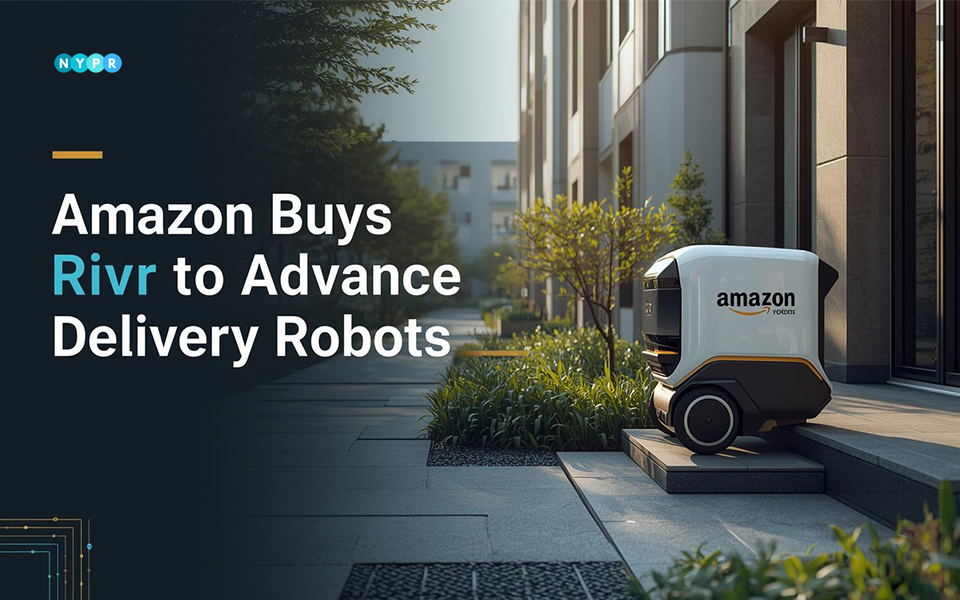
Rivr, a startup that delivers the stair-climbing robot, has been acquired by Amazon. The shift reinforces the automated logistics at Amazon. It is an indication to invest further in the last-mile delivery innovation.
This will transform the manner in which packages are delivered to households within the dense cities. It is likely to have an effect on businesses, consumers, and developers.
The Deal in Focus
Amazon has acquired Rivr, a robotics startup building compact delivery robots designed to navigate real-world obstacles, including stairs. Unlike traditional wheeled bots that struggle in urban environments, Rivr’s machines are built for complexity. They can climb steps, handle uneven surfaces, and operate in tight spaces.
This capability matters. Most last-mile delivery challenges happen at the doorstep, not on highways. Stairs, curbs, and narrow pathways often require human effort. Rivr’s technology directly targets that gap.
The acquisition fits into Amazon’s broader robotics and logistics strategy. Over the years, the company has invested heavily in warehouse automation, drone delivery, and AI-powered logistics systems. This latest move extends that focus beyond fulfillment centers into neighborhoods and residential areas.
The announcement included a note from RIVR’s CEO and co-founder, Marko Bjelonic:
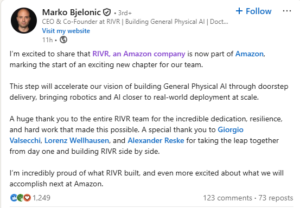
“I’m excited to share that RIVR is now part of Amazon, marking the start of an exciting new chapter for our team.”
The message reflects both a transition and a continuation. Rivr’s technology will now operate within Amazon’s larger infrastructure, potentially accelerating its development and deployment.
As part of the transition, the team also acknowledged the journey behind the company’s growth:
“A huge thank you to the entire RIVR team for the incredible dedication, resilience, and hard work that made this possible. A special thank you to Giorgio Valsecchi, Lorenz Wellhausen, and Alexander Reske for taking the leap together from day one and building RIVR side by side.”
This Amazon deal highlights a clear direction. Amazon is not just improving delivery speed. It is rethinking how delivery happens at the final step.
Why This Move Stands Out?
This action strengthens the Amazon effort to get into real-life automation, particularly in the most complicated aspect of delivery. It is an indication that the future of robotics in warehouses is moving to doorstep intelligence, whereby AI and machines work in normal settings.
A. Solving the Last-Mile Challenge
Last-mile delivery remains one of the most expensive and complex parts of logistics. Human labor, traffic conditions, and infrastructure limitations all add friction.
By integrating Rivr’s robots, Amazon is addressing a very specific challenge: the final few meters of delivery. A robot that can climb stairs changes what automation can realistically achieve in cities. This could reduce delivery time, lower costs, and improve consistency.
B. Taking Automation Into the Real World
Amazon has already automated large parts of its warehouses. The next frontier is outside those controlled environments.
Rivr’s robots are built for unpredictable conditions. This makes them suitable for real-world deployment at scale.
“This step will accelerate our vision of building General Physical AI through doorstep delivery, bringing robotics and AI closer to real-world deployment at scale.”
That idea goes beyond delivery. It points to a future where robots interact more naturally with everyday environments.
C. Smarter Machines, Real-World Decisions
The integration of AI with robotics is key. These machines are not just moving packages. They are learning to navigate environments, make decisions, and adapt in real time.
This is where the concept of an Amazon delivery robot evolves. It becomes less about automation and more about intelligent systems operating independently.
Who This Impacts
The impact extends across businesses, consumers, and the broader robotics ecosystem. The shift affects all people who work in modern logistics because it changes delivery standards and increases competitive challenges.
A. What It Means for Companies
Retailers and logistics companies will watch closely. Amazon’s successful implementation of this technology will create new benchmarks for delivery efficiency.
Competitors will need to spend money on matching systems to maintain their market position. Smaller logistics providers must adopt automation technology at a faster pace than their original schedule.
B. How It Changes Everyday Deliveries
For customers, the impact may appear gradually. Deliveries could become faster and more predictable, especially in dense urban areas.
There may also be changes in how packages are received. Instead of a person, a robot could arrive at the doorstep, even in buildings with stairs.
This could reshape expectations around Amazon package delivery over time.
C. What It Means for Builders and Innovators
For engineers and robotics companies, this acquisition signals opportunity and competition.
It validates the importance of real-world robotics. Startups working on mobility, AI, and automation may find increased interest and investment.
At the same time, Amazon’s scale makes it a dominant player. That could influence how the broader ecosystem evolves.
What Comes Next?
The next step is testing this in real environments. How well it works at scale, and how people respond to it, will decide how quickly it becomes part of daily delivery.
A. Where Delivery Robots Are Headed?
The next phase will likely focus on testing and deployment. Amazon may begin integrating Rivr’s robots into pilot programs across select cities.
The key question is reliability. Can these robots handle diverse environments consistently? If yes, adoption could expand quickly.
B. Amazon’s Next Moves
Amazon is expected to combine Rivr’s technology with its existing systems. This could include AI navigation, mapping tools, and logistics data.
The goal will be seamless integration. From warehouse to doorstep, every step could become part of a connected system. Over time, this could reduce human involvement in routine deliveries while improving efficiency.
C. Challenges Still to Solve
Several challenges remain.
- Regulation is one. Cities may need new rules for robots operating in public spaces.
- Scalability is another. Deploying robots across different regions requires adaptation.
- Public acceptance will also play a role. People need to trust and feel comfortable with robotic delivery systems.
These factors will shape how quickly the technology spreads.
Looking at the Long-Term Impact
Amazon’s acquisition of Rivr marks a clear step toward redefining last-mile delivery. Faster shipping serves as only one aspect of the system, which will change all processes involved in moving products to their last destinations.
The decision shows how logistics practices are changing throughout the industry. Businesses today use automation technology in both planned surroundings and uncontrolled situations that occur during their regular operations.
The speed of this transition process will depend on three factors: execution methods, regulatory frameworks, and public reaction. The path ahead toward future delivery systems has become evident. Delivery systems now operate with increased autonomy, advanced intelligence capabilities, and deeper connections to the daily routines of people.











Leave a comment