

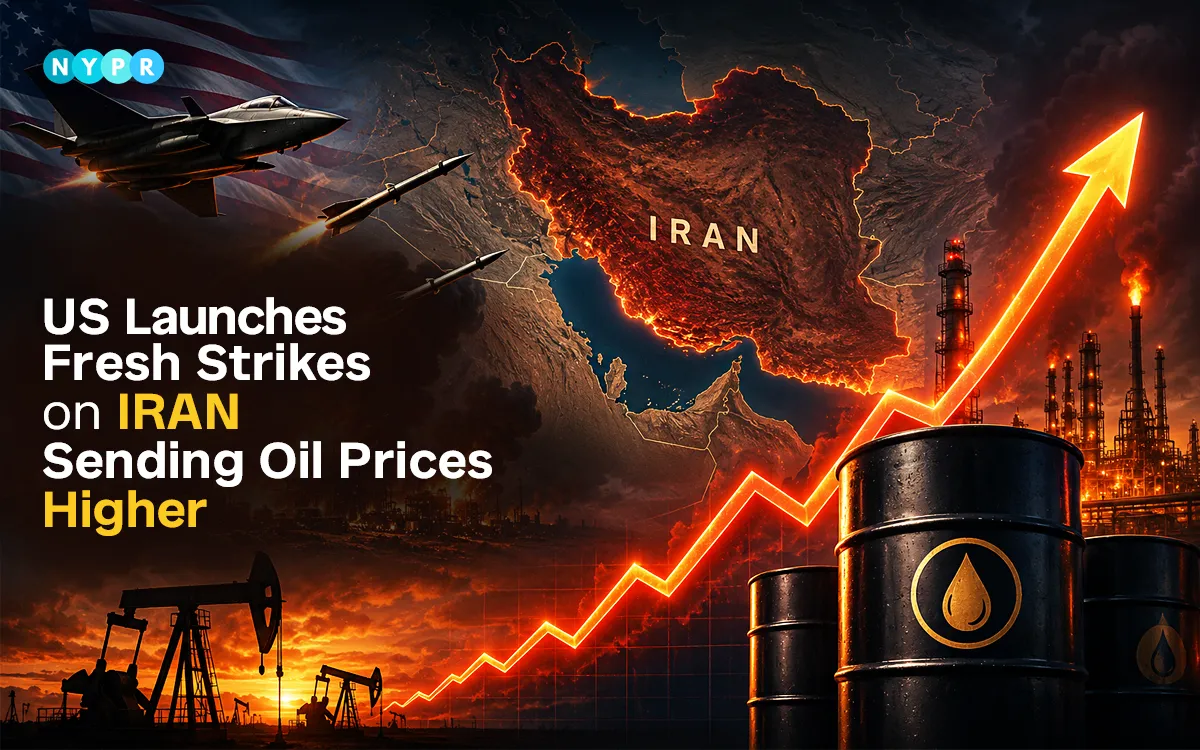
A fresh wave of military action in the Middle East is once again shaking global markets. The US launches fresh strikes on Iran, sending oil prices to their highest level in more than two weeks. The move has also renewed concerns over the Strait of Hormuz shipping crisis, a key route for the global oil trade. Even though oil production has not seen major disruptions, traders fear the conflict could affect shipping. That concern alone has been enough to lift crude prices.
Brent crude futures settled more than 5% higher at $78.02 a barrel. They later climbed to $79.28 in post-settlement trading. U.S. West Texas Intermediate (WTI) crude also gained. It rose from $73.52 to $74.76 a barrel. The sharp increase shows how quickly energy markets react when an important shipping route faces new risks.
The latest escalation followed comments from U.S. President Donald Trump. He said the interim agreement aimed at ending the conflict was “over.” He also warned that additional strikes could begin as early as Wednesday night. However, he ruled out a full-scale war. His remarks added fresh pressure to already nervous markets.
Soon after, U.S. Central Command confirmed a new round of military operations. Officials said the goal was to keep the Strait of Hormuz open for commercial shipping. Iranian media reported explosions in Bandar Abbas, Abu Musa, Bushehr, and several other locations. A U.S. official also said the latest operation was expected to be larger than the strikes carried out a day earlier.
Why did oil prices react so quickly? The answer lies in the Strait of Hormuz. The waterway carries nearly one-fifth of the world’s oil supply. Think of it as a major highway for oil tankers. If ships face delays or security threats, transport costs can rise. Buyers also worry about future supplies. As a result, oil traders often push prices higher before any actual shortage takes place.
Key developments driving the market:
- Fresh U.S. strikes on Iran have increased concerns about regional security and global energy supplies.
- The Strait of Hormuz shipping crisis has deepened after attacks on commercial vessels. Maritime authorities have raised the threat level to “severe.”
- Shipping and insurance costs may rise if security risks continue, adding pressure to global trade.
- Energy traders are adding a risk premium as fears of further disruption continue to grow.
The latest fighting follows Iranian attacks on commercial vessels in the Strait of Hormuz. After those attacks, Washington withdrew sanctions relief under last month’s interim agreement. The deal had allowed Iran to export limited amounts of oil. Iran later said it had targeted U.S. military sites in Bahrain and Kuwait. The United States responded with another round of strikes.
The US strikes Iran oil story reaches far beyond the Middle East. Higher crude prices can increase transport costs for airlines, shipping companies, and manufacturers. If energy costs stay high, businesses may pass those costs on to consumers. That can affect fuel prices and add pressure on inflation. This is why investors are watching every new development so closely.
The Guardian also reported that investors moved money into safer assets as concerns over a longer conflict grew. Brent crude briefly traded above $79 a barrel. Analysts say the current rally is being driven more by concerns over future supply risks than by actual production losses. That shows how quickly confidence can change when tensions rise around a key shipping route.
For now, the US launches fresh strikes on Iran keeping markets focused on regional tensions. Supply shortages have not become a major concern.If ships continue moving safely through the Strait of Hormuz, oil prices could begin to settle. However, that could change if new attacks target commercial vessels or energy infrastructure. In that case, markets are likely to remain under pressure. The conflict is no longer just a regional security issue. It has become a major test for global energy supply chains, and markets are likely to react to every new development in the days ahead.
Author’s Note:
The latest military strikes have shifted the market’s focus from today’s oil prices to what happens next. The key question now is whether shipping through the Strait of Hormuz can continue without further disruption. If tensions ease, markets may stabilize. But any new














Leave a comment