

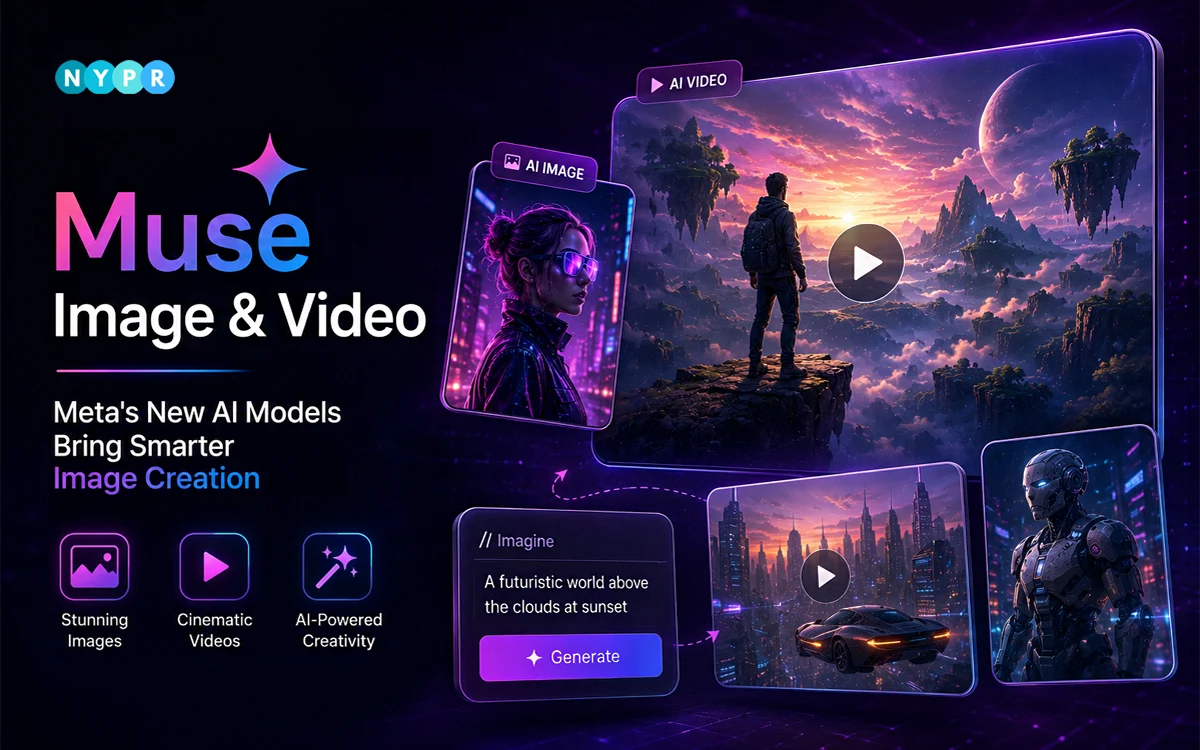
Meta launched Muse Image on July 7, 2026. It’s the first AI image tool built by Meta Superintelligence Labs, announced on Meta’s official AI blog. Meta also showed an early preview of a video model called Muse Video. Both tools aim to cut Meta’s reliance on outside AI models like Midjourney. This is the second big release from the AI team led by Alexandr Wang, after April’s Muse Spark model.
Key Takeaways:
- Muse Image is live now on the Meta AI app, Meta.ai, Instagram Stories (US), and WhatsApp in some countries. Facebook and Messenger are coming soon.
- Muse Video is still being tested. Meta needs to fix fast-motion scenes and audio syncing before it goes public.
- It beats some rivals, not all. Meta says Muse Image beats Google’s Nano Banana 2 on several editing tasks. It still trails OpenAI’s GPT Image 2 on overall quality, according to CNBC’s reporting.
- A new watermark tool, Content Seal, tags AI images with a hidden signal. It stays even after cropping, resizing, or a screenshot.
Most AI tools make a picture the moment you send a prompt. Muse Image works differently. First, it checks your request. It can search the web for facts, run code to build things like QR codes and charts, and fix its own mistakes. Then it shows you the final image.
Meta says this extra step means fewer redo prompts and better results on the first try. It’s part of a wider push across Meta’s apps, similar to how theMeta Pocket app turns a single text prompt into a playable game.
Core Features:
- Web search for prompts based on real events or facts
- Code generation for working QR codes, charts, and graphs
- Self-editing to catch small mistakes before showing the image
- Multi-image blending to combine people, places, or outfits into one photo
- Instagram tagging, which pulls in a public user’s photos when you mention their username (this is opt-out, not opt-in)
- Muse Spark support for animated and interactive projects
Muse Image isn’t a separate app. It’s built right into apps people already use:
- Meta AI app and Meta.ai — live today
- Instagram Stories — live in the US, with 30+ new AI effects, building on the platform’s recentInstagram Plus subscription tools
- WhatsApp — live in select countries
- Facebook and Messenger — coming later this year
It’s free to use. Paid Meta subscriptions get higher usage limits.
Meta’s own tests show Muse Image beats Nano Banana 2 on editing tasks, but falls short of OpenAI’s GPT Image 2 on quality. So it’s competitive, but not the clear leader. This launch also ends Meta’s partnership with Midjourney, which used to power image tools inside Meta AI.
Muse Video shares the same base model as Muse Image and adds sound. Meta says it already ranks No. 3 in a public video-quality leaderboard. But two problems remain: syncing sound to video, and rendering fast motion well. Meta hasn’t given a public release date yet. The stakes are high given that OpenAI shut down its own Sora video app earlier this year while it rethinks its AI video strategy.
As AI images get harder to spot, Meta built Content Seal, a hidden watermark. It survives cropping, resizing, and screenshots. Meta is also testing a tool that lets people check if an image carries this watermark. Video watermarking is coming next. Content controls like this echo a broader industry trend, including Cloudflare’s new AI crawler policy that gives website owners more say over how AI tools use their content.
Meta isn’t just racing to make AI faster anymore. It’s racing to make AI more accurate and more trustworthy. That shift also helps Meta’s business: less spending on outside AI tools, and a faster way for advertisers to make ad content.
The launch isn’t free of controversy, though. The opt-out photo-tagging feature has already drawn criticism, especially given Meta’s past privacy issues, including its $5 billion FTC fine over Cambridge Analytica in 2019, as TechCrunch reported. How Meta handles that criticism, and whether Muse Video ships without its current flaws, will shape how this launch is remembered.
Author’s Note:
AI tools are becoming part of everyday work, but speed alone is no longer enough. What matters now is whether they can create content people can trust. Meta’s latest launch shows where AI is heading. The focus is no longer just on creating content faster. It’s also about making AI more accurate, transparent, and useful in everyday work.











Leave a comment