

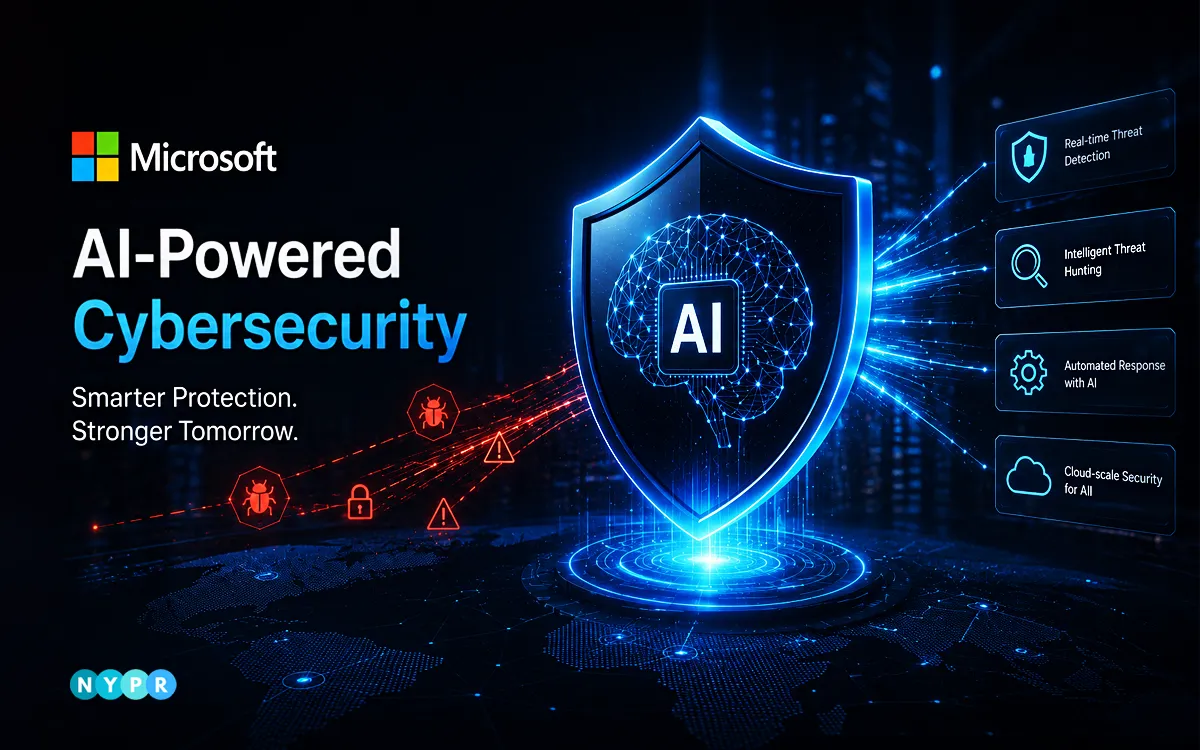
Cyberattacks are changing fast. Attackers are now using AI to scan software, spot weak points, and launch attacks in far less time than before. That is making it harder for businesses to protect their systems.
Microsoft says security teams need AI that can keep up with that pace. On Monday (July 27, 2026), Microsoft introduced MAI-Cyber-1-Flash. It is the company’s first dedicated Microsoft cybersecurity AI model. It also announced Project Perception, a new platform that brings several AI agents together to support security work. Together, the two launches help businesses detect software flaws earlier. They also highlight the most serious risks. That gives security teams more time to respond before attackers can exploit them.
For years, security teams relied on regular scans and manual code reviews to find software flaws. That worked when updates were released less often. Today, software changes much faster. Many apps are updated several times a day. At the same time, attackers are using AI to search for weak spots in minutes. Even one missed flaw can open the door to a cyberattack.
Microsoft says traditional security tools are struggling to keep up. That’s why it built MAI-Cyber-1-Flash. The model is not designed for general tasks like writing or coding. Instead, it focuses on one job: finding software vulnerabilities.
Think of it as a security expert that never stops reviewing code. It can scan large projects, flag risky issues, and help engineers decide what needs to be fixed first. That allows security teams to spend less time searching for problems and more time solving them. Microsoft is not relying on one AI system to handle every security task. Instead, it gives different jobs to different models. That makes the platform faster and more efficient.
Microsoft says MDASH achieved 96% on the CyberGym benchmark when paired with MAI-Cyber-1-Flash. “We have MAI-1 Cyber Flash with GPT-5.4 inside the MDASH harness, which beats Gemini, GPT 5.5 Cyber, GPT 5.6 Sol, and Mythos 5 on Cyber Gym,” said Mustafa Suleyman, CEO of Microsoft AI.
Microsoft says this approach also lowers computing costs. The company estimates it can cut AI operating costs by nearly 50% while still delivering strong results.
During testing, Microsoft paired MDASH with MAI-Cyber-1-Flash. The company said the platform achieved a 96% score on the CyberGym benchmark. The company also reported that the system performed better than models from Mythos, Gemini, and GPT in its evaluation. Even so, benchmark scores are only part of the story. The real test will be how well the platform protects businesses from real-world attacks after deployment.
Microsoft also introduced Project Perception, a new platform built to support security teams. Instead of relying on one AI assistant, the platform uses several AI agents. Each one is assigned a specific job. One looks for suspicious activity. Another checks software flaws. Others suggest fixes or help automate routine tasks.
Think of it like a hospital. A patient does not rely on one doctor for everything. A surgeon, a radiologist, and a nurse each have a different role. Together, they solve the problem more efficiently. Microsoft believes the same approach can improve cybersecurity. AI agents can take care of repetitive security tasks. That allows security experts to focus on complex threats where human judgment matters most.
Microsoft’s announcement is about more than a new security tool. It shows how enterprise cybersecurity is evolving as AI becomes part of both defense and cybercrime.
- Attackers are moving faster. AI can help hackers find security flaws in much less time than before.
- Businesses need always-on protection. Regular security scans are no longer enough for software that changes every day.
- Focused AI is gaining ground. Companies are building AI tools for specific jobs instead of relying on one model for everything.
- Automation will support security teams. AI can take over routine work, giving experts more time to investigate serious threats and respond quickly.
Microsoft says MAI-Cyber-1-Flash was trained using decades of cybersecurity experience. The model also draws on insights from more than 100 trillion security signals every day. These signals come from cloud services, identities, endpoints, applications, and networks. Before the launch, Microsoft put the model through AI red-team exercises. It also completed adversarial testing and independent security reviews.
Even so, the platform’s long-term success will depend on how it performs outside controlled testing. Businesses will expect faster threat detection. They will also look for fewer false alerts and stronger protection against real attacks.
The launch also highlights a growing shift across the AI industry. Instead of building one model that does everything, companies are creating AI systems with a clear purpose. Microsoft’s latest release shows where the industry is heading. This approach could soon become the new standard for cybersecurity.
Author’s Note:
Cyber threats are evolving fast, and security teams are under more pressure than ever. Microsoft’s latest launch shows that AI is becoming a practical tool for cybersecurity, not just a chatbot. As covered in this New York press release, the real test is still ahead. The platform will need to prove it can stop real-world attacks, not just perform well in benchmarks.












Leave a comment