

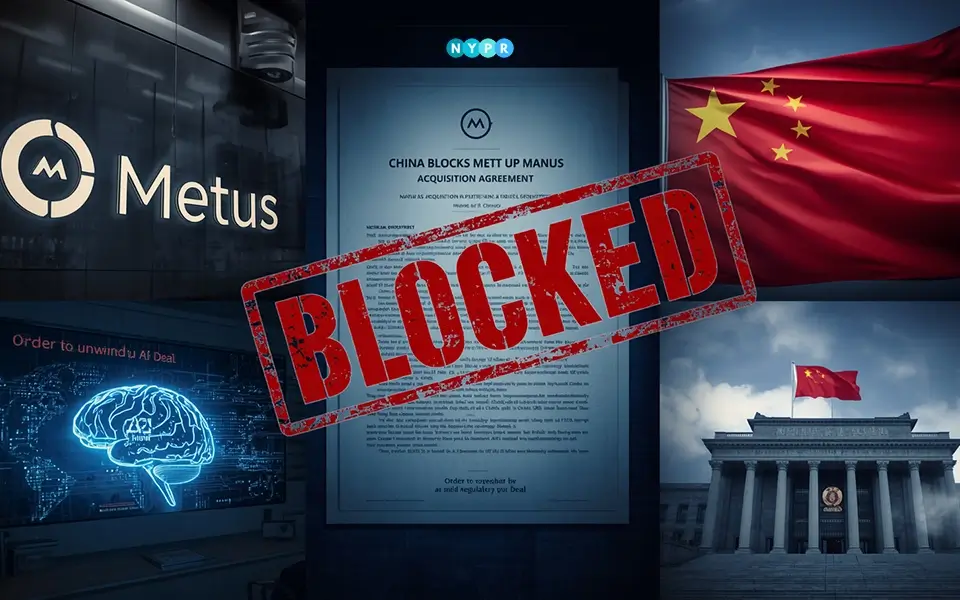
China has demanded that Meta Platforms reverse its $2 billion deal to acquire AI Startup Manus, escalating tech oversight. This decision marks a crackdown on international AI transactions. It also addresses concerns over data, intellectual property, and national security.
The move impacts international investors, startups, and tech giants alike. It shows that geopolitics is playing a role in future AI development. More generally, it confirms AI is no longer a commercial, but a strategic, technology.
When the Agreement Was Forced to Unwind
China’s National Development and Reform Commission (NDRC) stepped in to block Meta’s planned acquisition of AI Startup Manus. The deal, valued at over $2 billion, had already moved forward before regulators intervened.
Authorities ordered the transaction to be reversed entirely. In a direct statement, the NDRC said it would “prohibit foreign investment in Manus…and require the parties involved to withdraw the acquisition transaction.”
Manus had recently restructured its corporate base to Singapore following a $75 million funding round. The move was widely seen as an attempt to position itself outside mainland China’s regulatory scope.
However, regulators traced the company’s core operations, including research and development, back to China. This became central to the investigation.
The timeline unfolded quickly. Initial scrutiny began after the restructuring, followed by a deeper review of ownership, data flows, and technology origin. Enforcement came soon after, with a clear directive to unwind the deal.
Reports also indicate that Manus founders Xiao Hong and Ji Yichao have faced travel restrictions, underscoring the seriousness of the regulatory action.
Where AI Collides With National Interests
The decision reflects a broader shift where AI is treated as a national security asset rather than just a business opportunity.
Governments are increasingly focused on controlling access to advanced technologies, skilled talent, and large-scale data. AI sits at the center of this shift.
Weiheng Chen of Wilson Sonsini noted that China’s national security clearance may become a “regular closing condition for cross-border tech deals.”
Alfredo Montufar-Helu from Ankura China Advisors added that AI is now clearly tied to national security priorities, making such deals more complex and politically sensitive.
For global markets, this signals a new phase. Cross-border mergers in AI are no longer judged only on financial or operational grounds. Strategic implications now carry equal weight.
China’s Expanding Grip on Tech Oversight
China’s approach suggests a broader expansion of regulatory jurisdiction. Incorporation location alone is no longer enough to define oversight.
Authorities are now examining multiple layers, including where the technology was developed, where research teams are based, how data is processed, and the nationality of founders.
Carl Li of Zhong Lun explained that deals may increasingly be reviewed as transfers of technology and data, not just traditional mergers and acquisitions.
This shift makes it harder for companies to restructure offshore to avoid regulatory scrutiny.
The Manus case highlights this clearly. Despite its Singapore registration, its operational roots in China placed it firmly within regulatory reach.
The Ripple Effect Across the Tech Landscape
The impact is felt throughout the global tech ecosystem for companies, founders, developers, and investors alike. What may have been one transaction now has broader implications for the international operations of AI companies.
The move marks a tighter regulatory environment and a more complicated landscape for AI companies looking to expand globally, from Big Tech to early-stage startups.
1. Pressure on Global Tech Giants
Meta responded by stating, “The transaction complied fully with applicable law. We anticipate an appropriate resolution.”
For large tech firms, this introduces a new layer of uncertainty. Even completed or near-complete deals may face reversal if regulators intervene.
This is particularly relevant for companies investing in AI agents and next-generation tools built on large language models. Manus was seen as a key player in this space.
2. A Wake-Up Call for Founders
The case sends a clear signal to startups considering relocation strategies. The concept of “Singapore washing,” where companies shift headquarters abroad while retaining core operations in China, is now under scrutiny.
Ben Chester Cheong from Singapore University of Social Sciences said this development raises the compliance threshold but does not end relocation strategies entirely.
Founders will need to rethink how they structure global operations, especially in sensitive sectors like AI.
3. Impact on the AI Development Layer
Manus played a role in developing AI agents that build on top of large language models. These tools are becoming essential across industries, from automation to enterprise software.
The disruption of the deal could slow development timelines and partnerships tied to such technologies.
For developers, it reinforces the idea that technical innovation is now closely tied to regulatory environments.
4. Investor Sentiment Turns Cautious
The decision is already influencing investor sentiment. Venture capital firms are becoming more cautious about cross-border AI investments.
This aligns with broader market news, where geopolitical risks are increasingly factored into valuations.
In the stock market segment, such regulatory actions can trigger volatility, especially for companies heavily invested in international AI expansion.
Navigating an Uncertain Future
Unravelling such a transaction is complicated. This includes financial, legal, and operational changes in multiple jurisdictions.
We are also unclear about how it will be enforced. There is uncertainty around which countries apply grace periods and penalties.
The move comes at a time of heightened geopolitical tensions and comes ahead of future interactions between the U.S. and China. In the meantime, firms will take a more circumspect view on international AI deals.
A New Era for Cross-Border AI Deals
The blocking of Meta’s acquisition of AI Startup Manus marks a turning point.
AI is no longer just an area for innovation and competition. It is becoming embedded in the nation’s infrastructure, as a matter of security, power, and strategy.
In turn, the rules are changing. Cross-border deals will face deeper scrutiny, and global tech investments may become more fragmented.
From Big Tech firms to early-stage startups, the decision signals tighter oversight and a more complex path for international expansion in the AI space.

















Leave a comment