

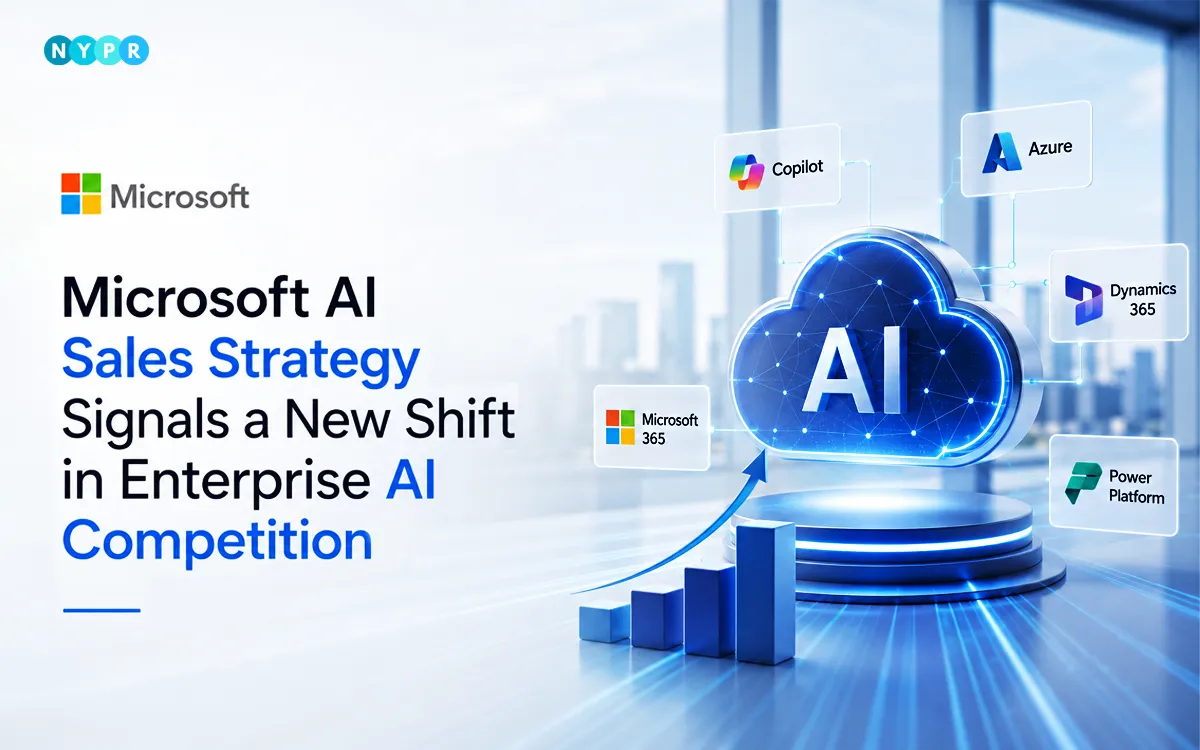
The AI race is changing fast. Building a powerful AI model is no longer enough. Companies also need to show why customers should choose their AI platform. The reported Microsoft AI sales strategy reflects a bigger shift in the AI industry. Companies are now competing beyond AI models to win enterprise customers.
According to a Bloomberg report, Microsoft held an internal meeting on Tuesday (i.e., on 14-7-26). The meeting was part of the company’s FY27 planning. During the session, Microsoft executives spoke with sales teams.They asked them to compare Microsoft’s AI products with OpenAI, Anthropic AI, and Google’s Gemini. The company reportedly wants sales teams to focus on what makes Microsoft’s AI ecosystem different. That includes lower operating costs, built-in security, and strong integration across its products.
Executive Vice President Jay Parikh summed up the approach with a simple message:
“Everyone else is selling parts, we’re selling the full end-to-end system.”
In simple words, Microsoft is not trying to sell just one AI chatbot. It wants businesses to adopt a complete AI platform. That platform includes Azure, Microsoft 365, Copilot, and Windows. It also brings together security services and the company’s growing Microsoft AI models.
According to the reported plan, Microsoft’s sales teams will focus on:
- Easy integration across Microsoft 365, Azure, and Windows.
- Lower operating costs for business customers.
- Built-in security and compliance features.
- One connected AI platform instead of separate AI tools.
- Better long-term value from a single ecosystem.
Think about an office that already uses Outlook, Excel, Teams, and Windows every day. Now imagine the company wants to add an AI assistant. Choosing one that already works inside those apps is often easier than adding a completely new system. Employees can keep using the tools they already know. Microsoft reportedly wants its sales teams to highlight that advantage.
Bloomberg also reported another comparison from the meeting. Executive Vice President Jacob Andreou compared Microsoft Copilot with Anthropic’s Claude. According to the report, he said Claude was slower inside Microsoft Office apps. He also claimed it was less accurate for some tasks. Bloomberg added that Claude lacked Microsoft’s built-in security integrations.
Neither Microsoft nor Anthropic had publicly commented on the report when this article was published. TechCrunch said it had also contacted both companies for a response.
The reported approach stands out for another reason. Microsoft remains one of OpenAI’s biggest investors and partners. At the same time, it continues to expand its own AI technology. That means the two companies work together in some areas while competing for many of the same business customers.
The report also highlights a bigger trend across AI tech. Leading companies are moving beyond standalone AI models. They are building complete workplace platforms instead. As AI in work becomes more common, buyers are looking beyond AI performance. They also compare security, pricing, integration, and ease of use before making a decision.
Microsoft’s AI sales strategy shows how the AI market is evolving. Today, enterprise buyers want more than a smart chatbot. They want AI that fits their existing software, protects company data, and supports everyday work. Those priorities could shape the next stage of Microsoft vs. OpenAI and the wider enterprise AI competition.
Author’s Note:
Enterprise AI is entering a new stage. Businesses now want AI that works seamlessly with their existing tools, protects company data, and delivers real value. That shift could define the next chapter of AI competition. NYPR News will continue to cover these developments, providing timely insights into how enterprise AI is reshaping business strategies, workplace technology, and the competitive landscape.













Leave a comment