

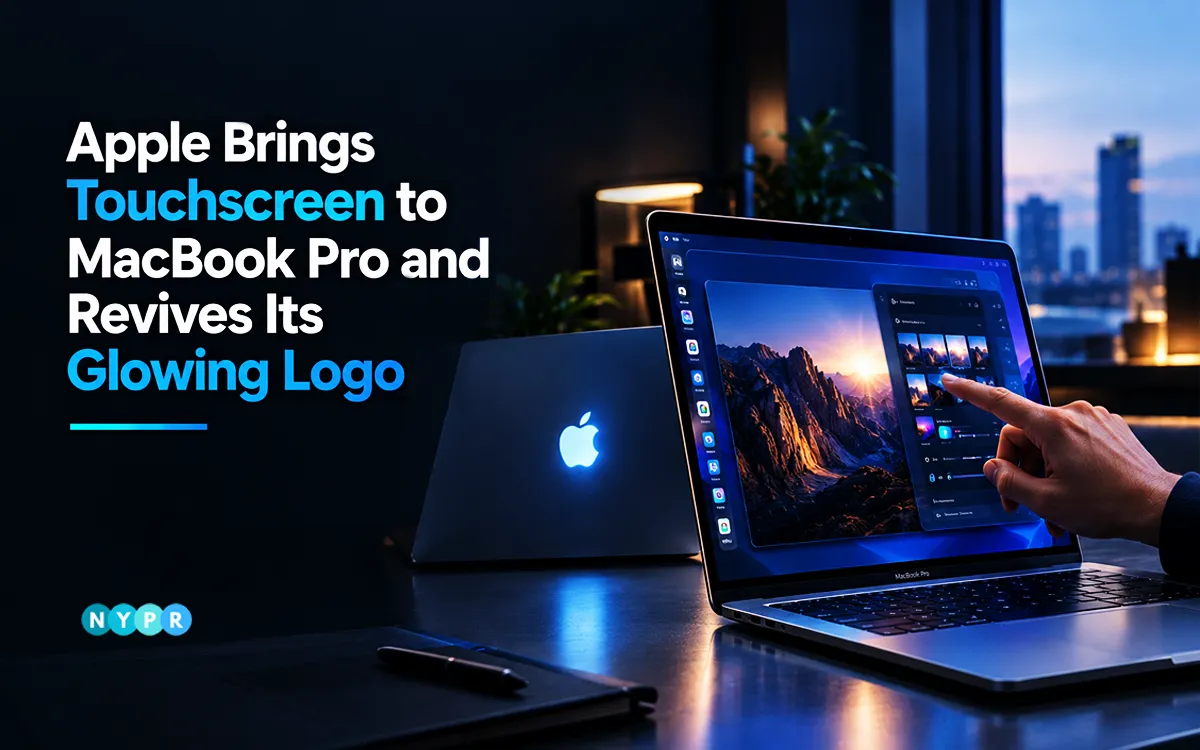
Apple has introduced a touchscreen MacBook Pro for the first time, bringing a major change to its professional laptops. Announced on October 28, 2026, the new 14-inch and 16-inch models feature a tandem OLED display and M5 Pro or M5 Max chips. The launch also brings back the glowing Apple logo on the laptop’s lid. The key question is whether these changes will make professional work easier and justify Apple’s premium prices.
Apple’s PROLED XDR display uses tandem OLED technology. Apple says it offers up to 2,000 nits of peak HDR and SDR brightness, a 10,000,000:1 contrast ratio, and refresh rates up to 120Hz. It also supports P3 and Adobe RGB color spaces.
These features target photographers, designers, and video editors. For example, better contrast helps editors work with dark scenes and bright highlights in HDR videos. Independent testing will show how the display performs in everyday use.
Users can zoom into photos, move presentation slides, and interact directly with supported apps. Apple has also optimized Final Cut Pro, Logic Pro, and Pixelmator Pro for touch controls.
Both chips are designed for demanding professional work, but their specifications suit different workloads. The M5 Pro offers up to a 20-core GPU, while the M5 Max adds configurations with 32-core or 40-core GPUs. The M5 Max also supports more unified memory and higher memory bandwidth.
| Feature | M5 Pro | M5 Max |
| CPU options | 15-core or 18-core | 18-core |
| GPU options | 16-core or 20-core | 32-core or 40-core |
| Memory bandwidth | 307 GB/s | 460 GB/s or 614 GB/s, depending on GPU |
| Maximum unified memory | Up to 64GB | Up to 128GB |
| Video encoding engines | One video encode engine and one ProRes encode and decode engine | Two video encode engines and two ProRes encode and decode engines |
| SSD storage options | 1TB, 2TB, or 4TB | 2TB, 4TB, 8TB, or 16TB |
Specifications vary by model and configuration. See Apple’s technical specifications for details.
The M5 Pro is a practical choice for many professional workloads, including software development, photo editing, and video production. The M5 Max is better suited to graphics-heavy tasks, complex 3D projects, and workflows that benefit from greater memory capacity and faster data transfer.
Apple chief hardware officer Johny Srouji called the launch “a monumental step forward for the Mac.”
Touch controls will be most useful for visual tasks, such as editing videos, drawing, and working with images. However, they are unlikely to replace the keyboard and trackpad for users who rely on shortcuts throughout the day.
Another notable design change is the return of the illuminated Apple logo on the laptop’s lid. The feature disappeared from the MacBook Pro in 2016. The illuminated Apple logo adjusts to the screen’s brightness, adding a subtle glow to the laptop’s lid rather than blinking on and off.
The new models are also thinner and lighter than their predecessors. These changes give Apple a mix of familiar design and new features without focusing entirely on processing power.
Touchscreens are already available on many Windows laptops. Microsoft’s Surface Laptop and Dell’s XPS range are two examples. Apple’s challenge is to make touch useful within macOS and the creative apps professionals use every day.
Reuters reported that 33.4 million touchscreen notebooks shipped worldwide in 2025, with an average selling price of about $1,009. Apple’s new MacBook Pro starts at $2,899 in the US.
That price gap matters. Touch alone will not make the MacBook Pro stand out. Its long-term appeal will depend on the value it offers in display quality, software, and performance. These features must give professionals a strong reason to upgrade from their existing laptops. In the US, the 14-inch M5 Pro model starts at $2,899, while the 16-inch version starts at $3,399. M5 Max models start at $4,499 and $4,799, respectively. US availability begins November 6.
Author’s Note
The new MacBook Pro is more than a routine upgrade. Its touchscreen and glowing Apple logo refresh the familiar design. The tandem OLED display is designed for creative professionals. For New York Press Release readers, the real question is whether these changes justify the premium price.














Leave a comment