

Key Takeaways:
- Valorant transformed the traditional tactical shooter formula by combining precise gunplay with agent-based abilities.
- Riot Games modernized tactical shooter mechanics through accessibility, evolving metas, and utility-driven strategy systems.
- Valorant esports growth continues globally through the VCT franchise ecosystem and international leagues.
- The game’s ability-focused tactical gameplay changed how modern FPS titles approach map control and team composition.
- With more than 33 million monthly players in 2026, Valorant remains one of the biggest competitive FPS games worldwide.
Before Valorant launched in 2020, tactical shooters were still dominated by the traditional Counter-Strike formula: precise gunplay, limited utility usage, and rigid strategic systems. Riot Games changed that formula by blending competitive FPS mechanics with character-based abilities, and the genre has not looked the same since.
What initially looked like “Counter-Strike with powers” quickly evolved into one of the biggest competitive FPS games in the world. By March 2026, Valorant reached an estimated 33.17 million monthly players, the highest figure in the game’s history, while Riot Games expanded the title into one of esports’ most financially sustainable ecosystems.
Six years later, Valorant is no longer just another tactical shooter. It has become the blueprint for how modern competitive FPS games approach strategy, accessibility, live-service updates, and long-term esports support.
What Makes Valorant a Tactical Shooter and Why Does It Feel Different?
Valorant took the foundation of traditional tactical shooters and evolved it with agent-based abilities, layered strategy, and utility-focused gameplay. While the game still rewards precision aim and teamwork, Riot Games introduced a more dynamic approach to map control and team composition. That balance between classic FPS mechanics and modern hero-style systems is what helped Valorant stand out in an already competitive genre.
1. How Valorant Reinvented Tactical Shooter Mechanics
At its core, Valorant follows the structure that defines a traditional tactical shooter:
- 5v5 gameplay
- attackers and defenders
- bomb-plant objectives
- round-based economy
- permanent deaths during rounds
These systems helped classic tactical FPS games thrive for decades. What changed with Valorant was the introduction of Agents, characters with unique abilities designed around specific tactical roles.
Duelists create openings; controllers shape map space, sentinels lock down sites, and initiators gather information or disrupt enemy positioning. That single design decision fundamentally changed tactical shooter mechanics.
Instead of relying only on aim and positioning, teams now build strategies around:
- utility timing,
- agent composition,
- ability combinations,
- and layered site execution.
A Viper wall can completely reshape map control. A Sova recon dart can expose hidden defenders. A Killjoy lockdown can force rotations before a gunfight even begins. The result is a tactical shooter with significantly more strategic depth and replayability than earlier genre staples.
2. Gunplay Still Comes First
One reason Valorant earned credibility so quickly among competitive FPS players is that Riot never abandoned precision gunplay.
Movement still affects accuracy. Headshots remain deadly. Peeking, crosshair placement, recoil control, and economy management still decide matches at the highest level. Unlike hero shooters, where abilities often overshadow weapon mechanics, Valorant uses abilities as tactical support systems rather than replacements for aim.
That design philosophy became critical to Valorant’s success. Riot Games modernized tactical shooter mechanics without abandoning the core precision that competitive FPS players value. Instead of replacing gunplay with abilities, the game used utility to enhance positioning, information control, and strategic execution.
That balance helped Valorant appeal to both hardcore Counter-Strike veterans and newer players entering the tactical FPS genre for the first time.
3. Utility Became More Important Than Raw Aim
Traditional tactical shooters often revolved around mechanical skill first and strategy second. Valorant shifted that balance.
Modern competitive matches are now heavily influenced by:
- smoke placement,
- flash coordination,
- post-plant utility,
- reconnaissance tools,
- and area denial mechanics.
Winning rounds is no longer just about taking better duels. Teams now focus on controlling information, denying space, and forcing opponents into uncomfortable situations before fights even begin. That evolution influenced the wider tactical shooter genre.
Many newer FPS titles now incorporate:
- layered utility systems,
- character-driven gameplay,
- and more dynamic map-control mechanics.
Valorant’s fingerprints are visible across modern tactical shooter design.
4. Riot Made Tactical Shooters More Accessible
One of Riot Games’ smartest decisions was making tactical shooters easier for newer players to approach without lowering the competitive skill ceiling.
Compared to older tactical FPS games, Valorant introduced:
- cleaner visual readability,
- simplified communication systems,
- more approachable interfaces,
- clearer ability feedback,
- stronger onboarding systems.
Even Riot’s Vanguard anti-cheat became part of the company’s broader push toward competitive integrity. This accessibility helped Valorant attract players who previously found tactical shooters intimidating or too punishing to learn.
At the same time, the game still maintained an extremely high competitive ceiling at professional levels, something many accessible shooters struggle to achieve.
5. Agent Identity Increased Replayability
Another major reason for Valorant’s long-term success is player identity. In older tactical shooters, players mainly specialized in weapons, positions, or maps. Valorant introduced a layer of identity through Agents, giving players distinct playstyles and strategic responsibilities.
That creates:
- stronger player retention,
- evolving metas,
- deeper team strategy,
- and constantly shifting gameplay experiences.
A Jett main approaches rounds differently than a Cypher main. Team compositions influence pacing, utility economy, and even psychological pressure during matches. This character-driven tactical structure helped Valorant feel fresh far longer than many traditional FPS games.
The Numbers Behind Valorant’s Growth in 2026
Valorant’s rise in 2026 reflects how far the game has expanded beyond a traditional tactical shooter audience. With more than 33 million monthly players at its peak, a billion-dollar cosmetic ecosystem, and one of the biggest esports scenes in gaming, the title continues to grow across both casual and competitive communities.
Its global reach, especially across Asia-Pacific and emerging esports regions, has helped establish Valorant as one of the defining FPS games of the modern era.
1. Player Base Reached Historic Highs
Valorant’s growth in 2026 shows that tactical shooters are no longer a niche genre.
According to ActivePlayer.io, the game reached approximately 37 million monthly players in March 2026, which is the highest figure in its history, following a massive growth surge between December 2025 and March 2026. Even after seasonal normalization, April 2026 still recorded nearly 33 million monthly players.
What makes those numbers especially impressive is the genre itself. Tactical shooters historically appealed to smaller competitive audiences compared to battle royale titles or arcade shooters. Valorant changed that perception entirely.
2. Valorant 2026 Key Stats
- Peak Monthly Players (March 2026): 33.17 million
- Registered Players Across Platforms: 35 million+
- Daily Active Users: 3.9 million
- All-Time Concurrent Record: 6.76 million
- Estimated Annual Revenue: Up to $900 million
- VCT Revenue Shared With Teams (2025): $105 million
3. A Billion-Dollar Cosmetic Ecosystem
Valorant also redefined how competitive FPS monetization could work without pay-to-win systems. The game generates revenue entirely through:
- weapon skins,
- battle passes,
- esports bundles,
- and cosmetic collections.
Players compete on equal footing regardless of spending.
That model proved extraordinarily effective because it aligned monetization with player identity rather than competitive advantage. Valorant’s cosmetic ecosystem became one of the most profitable in gaming, with annual revenue estimates ranging between $900 million and $1.3 billion in recent projections. Champions-themed cosmetic bundles alone generated massive spikes in player spending, with monthly cosmetic revenue reportedly peaking near $110 million during major VCT events.
Riot Games also connected cosmetics directly to esports through revenue sharing with VCT partner teams. In 2025 alone, Riot distributed over $105 million to partnered organizations, with approximately $86 million generated directly through esports-related digital item sales.
That structure helped establish one of the most financially stable esports ecosystems in modern gaming.
Valorant’s Global Expansion Changed Competitive FPS
Valorant’s competitive geography has shifted significantly since launch. Asia-Pacific now accounts for roughly 40% of the global ranked player base, overtaking North America as the game’s largest engagement region. Markets like the Philippines, Turkey, and South Korea have become major drivers of esports viewership and ranked participation, pushing Riot Games to expand localized broadcasts, regional leagues, and server infrastructure across these regions.
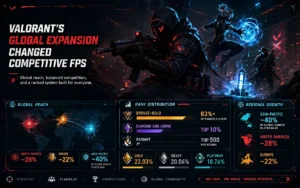
Valorant’s global popularity continues to grow, with North America’s player base representing approximately 28% of the total audience, while Europe accounts for nearly 22%. This worldwide distribution has helped Valorant build one of the most balanced and competitive esports ecosystems globally.
The game’s regional diversity is also one reason its esports scene continues to scale rapidly compared to many Western-focused multiplayer titles.
Valorant’s Rank Distribution Shows Why the Game Works for Everyone
Valorant’s ranking distribution highlights one of Riot’s biggest design successes: accessibility without sacrificing competitive depth.
Bronze through Gold tiers account for more than 63% of ranked players, while Diamond and above represent roughly the top 10%. Radiant, the highest rank in the game, remains capped to the top 500 players per region, preserving elite competitive prestige while still giving casual players a rewarding progression system.
Gold remains the single most populated major tier at approximately 23.03% of players, followed by Silver at 20.06% and Platinum at 18.76%.
This distribution matters because it shows Valorant successfully balances:
- accessibility for new players,
- competitive progression,
- and high-level mastery.
Maintaining that balance six years after launch is one of the reasons the player base continues to grow.
How Did Valorant Esports Help the Game Dominate Competitive FPS?
The Valorant Champions Tour (VCT) became one of Riot Games’ biggest long-term strengths, turning the game into a global esports powerhouse within just a few years. Structured regional leagues, revenue-sharing systems, and massive international tournaments helped create a more sustainable ecosystem for teams and players.
Combined with strong Twitch viewership and creator-driven broadcasts, Valorant esports continues to push the game’s popularity far beyond traditional competitive FPS audiences.
The VCT Franchise Model Changed Esports Stability
The Valorant Champions Tour (VCT) became one of Riot’s biggest long-term advantages.
Instead of relying entirely on unstable open tournament ecosystems, Riot introduced:
- partnered leagues,
- structured regional competition,
- revenue sharing,
- and long-term organizational support.
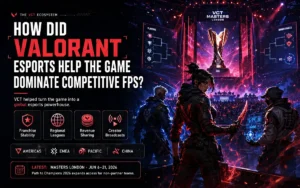
The ecosystem now spans:
- Americas
- EMEA
- Pacific
- China
This created a far more sustainable environment for teams, investors, players, and sponsors.
The franchise-style structure adopted in 2023 helped transform Valorant esports into one of the most financially transparent ecosystems in competitive gaming.
What’s the latest news?
- VALORANT Masters London 2026 is scheduled for June 6 to 21, 2026, which is the next major international VCT event. Riot has also announced the Path to Champions system for 2026, allowing non-partner teams to qualify from Stage 2 all the way through to Champions Shanghai within a single competitive season, further expanding esports access.
VALORANT Champions 2025 Broke Major Viewership Records
VALORANT Champions 2025 in Paris peaked at more than 1.47 million concurrent viewers, making it the third most-watched event in Valorant esports history. The tournament generated nearly 47.6 million hours watched across 102 hours of broadcast time, while co-streamers accounted for a record 58.4% of total viewing hours.
Those numbers reflect how deeply integrated creator culture has become within the Valorant esports ecosystem.
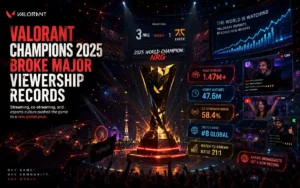
NRG Esports won the 2025 World Championship after defeating Fnatic in the grand final, while Arabic-language broadcasts set new viewership records for the game, highlighting the growing influence of Middle Eastern and North African audiences.
The annual esports prize pool itself also continues to climb, rising from $8.87 million in 2024 to approximately $10.41 million in 2025.
Streaming and Content Creation Continue Driving Growth
Valorant’s streaming ecosystem remains one of the strongest in gaming.
As of April 2026:
- Valorant ranked 8th globally on Twitch.
- averaged more than 64,000 concurrent viewers,
- and generated approximately 36.6 million watch hours over a 30-day period.
One of the most revealing metrics behind Valorant’s streaming dominance is its watch-to-stream ratio, which sits at approximately 21:1. In simple terms, viewers consume 21 hours of Valorant content for every single hour streamed.
That level of viewer concentration is unusually high for gaming and resembles audience behavior more commonly associated with traditional sports broadcasting rather than casual online streaming.
Valorant vs Counter-Strike: Key Differences That Changed FPS Gaming
Comparisons between Valorant and Counter-Strike 2 are unavoidable because both games share the same tactical FPS foundation. But the biggest difference is philosophy.
Counter-Strike prioritizes mechanical consistency and minimal gameplay variation. Valorant prioritizes evolving strategy through Agents, utility systems, and live-service balance updates.
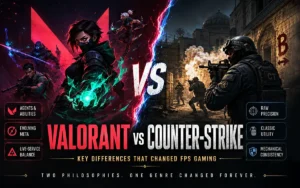
That makes Valorant:
- more dynamic,
- more meta-driven,
- and often more approachable for newer players.
Meanwhile, Counter-Strike remains more mechanically rigid and traditional. Neither design approach is inherently better. But Valorant succeeded because it modernized tactical shooter gameplay without abandoning competitive fundamentals.
Why Valorant’s Influence on Tactical Shooters Will Last
Valorant did not simply become popular. It permanently changed expectations for tactical shooters.
The genre before Valorant was largely defined by:
- static systems,
- limited strategic variation,
- and predictable gameplay structures.
Valorant introduced:
- character-driven tactics,
- evolving metas,
- utility-focused strategy,
- and live-service competitive balancing.
That forced the tactical FPS genre to evolve.
Even newer competitive shooters now borrow ideas tied to:
- hero-based utility,
- map-control systems,
- team composition strategy,
- and ability-driven tactical depth.
Beyond gameplay, Riot’s esports infrastructure has also become a reference point for sustainable competitive ecosystems.
Valorant did more than become successful. It reshaped expectations for what a modern tactical shooter could be, blending precision FPS mechanics, evolving team strategy, live-service balancing, and sustainable esports infrastructure into a single ecosystem.
Six years after launch, much of the tactical shooter genre is still adapting to the standard Riot Games created.
Frequently Asked Questions
How many people will play Valorant in 2026?
As of April 2026, Valorant has approximately 29.9 million estimated monthly players according to ActivePlayer.io, down from its all-time peak of 33.17 million in March 2026.
Why is Valorant esports growing so fast?
Valorant esports continues to grow because of Riot Games’ structured VCT ecosystem, regional leagues, revenue-sharing model, and consistent global support. The game also benefits from strong Twitch viewership, creator co-streaming, and expanding audiences across Asia-Pacific, Europe, and the Middle East.
What makes Valorant different from Counter-Strike?
The biggest difference between Valorant and Counter-Strike 2 is strategic variety. Counter-Strike focuses on traditional tactical shooter mechanics with minimal gameplay variation, while Valorant introduces Agents with unique abilities that constantly evolve team strategies, map control, and competitive metas.
Why is Valorant still popular in 2026?
Valorant remains popular in 2026 because Riot Games continues to support the game through regular updates, new Agents, competitive balancing, esports expansion, and seasonal content. Its combination of accessibility, deep tactical gameplay, and a globally active esports ecosystem has helped maintain one of the largest player bases in competitive FPS gaming.












Leave a comment