
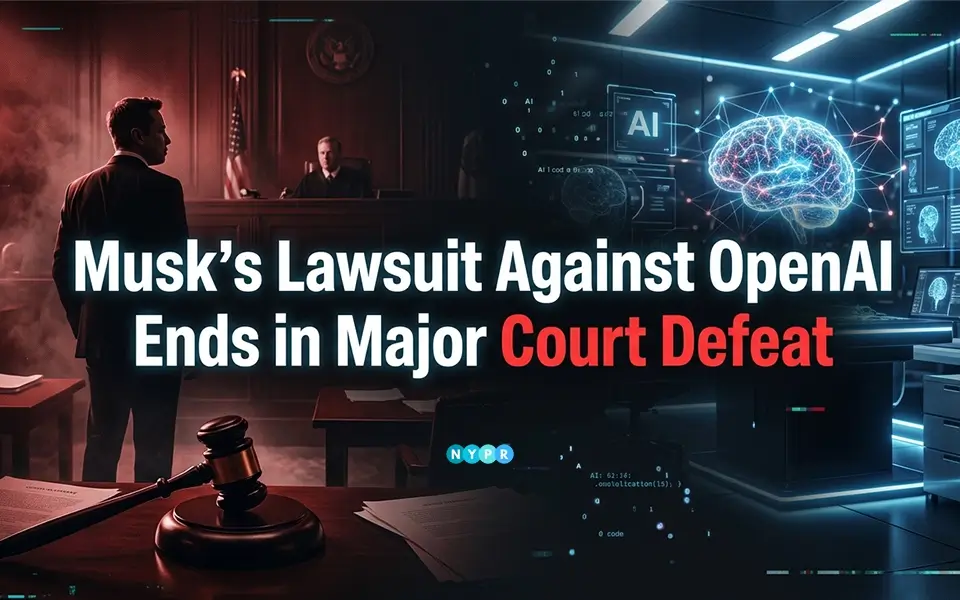
A California jury has ruled against Elon Musk in his legal battle with OpenAI, delivering a major courtroom victory for the artificial intelligence company and its leadership. The Elon Musk lawsuit against Sam Altman and OpenAI centered on claims that the company abandoned its original nonprofit mission and unfairly shifted toward a commercial structure.
Nine jurors returned a unanimous verdict after a short deliberation period, agreeing with OpenAI’s argument that Musk filed his claims too late under California law.
Key verdict takeaways:
- The jury sided with OpenAI on all major timing-related arguments.
- Jurors agreed Musk’s claims were filed after legal deadlines expired.
- The verdict came after a relatively short deliberation process.
- OpenAI avoided a potentially massive financial penalty.
The case became one of Silicon Valley’s most closely watched AI disputes because it questioned how OpenAI evolved from a nonprofit research lab into a multibillion-dollar AI company backed by Microsoft.
Musk originally helped launch OpenAI in 2015 before later separating from the organization amid disagreements over its direction and strategy.
Musk accused Sam Altman, Greg Brockman, OpenAI, and Microsoft of “stealing a charity” by creating a for-profit affiliate connected to Microsoft’s growing AI investments.
The trial focused on whether promises made to Musk during OpenAI’s early years were broken and when those alleged breaches occurred.
OpenAI relied heavily on a statute of limitations defense. A statute of limitations sets the legal deadline for filing claims in court. Jurors concluded Musk waited too long to bring several of his allegations.
OpenAI’s legal argument focused on these deadlines:
- August 5, 2021, for the first count
- August 5, 2022, for the second count
- November 14, 2021, for the third count
Jurors found that argument persuasive, leading to a relatively brief deliberation process before the verdict was delivered.
Musk’s lawsuit against OpenAI also revived wider debate around nonprofit governance, investor influence, and the commercialization of advanced AI systems.
The trial included testimony from prominent Silicon Valley figures and explored OpenAI’s dramatic internal history. Still, the verdict ultimately depended on narrow legal timing questions rather than broader debates about AI ethics or governance.
Judge Yvonne Gonzalez Rogers said after the ruling, “There was a substantial amount of evidence to support the jury’s finding…”
OpenAI lawyer Bill Savitt described the lawsuit as:
- “an after-the-fact contrivance”
- “a hypocritical attempt to sabotage a competitor”
During discussions over damages, Musk’s legal team estimated alleged wrongful gains between $78.8 billion and $135 billion. The judge questioned the logic behind comparing Musk’s charitable contributions to traditional startup investments.
The damages debate included:
- Claims tied to OpenAI’s rapid commercial growth
- Questions about nonprofit funding expectations
- Arguments over whether Musk’s early support resembled startup investment activity
The verdict also highlights how rapidly growing AI firms are increasingly facing governance disputes more commonly associated with large public corporations.
The ruling removes a major legal threat hanging over OpenAI as reports continue to circulate about potential IPO ambitions and long-term expansion plans.
OpenAI’s valuation has surged in recent years as generative AI adoption accelerated globally, making Musk’s lawsuit against OpenAI a closely watched case across both the technology and investment sectors.
Why the ruling matters for OpenAI:
- It removes uncertainty around a high-profile lawsuit.
- It strengthens OpenAI’s business stability ahead of possible IPO plans.
- It reassures major investors and partners.
- It allows the company to focus on AI product expansion.
Microsoft welcomed the verdict and reaffirmed its partnership with OpenAI following the decision.
The Sam Altman and OpenAI lawsuit also drew attention because of its broader implications for nonprofit structures, investor influence, and control over advanced AI technologies.
Following the verdict, Musk said Altman and Brockman enriched themselves by “stealing from a charity.”
He also announced plans to appeal the case to the Ninth Circuit Court of Appeals, signaling that Musk’s lawsuit against OpenAI is unlikely to end anytime soon.
Musk’s next legal steps:
- Appeal the verdict before the Ninth Circuit.
- Continue challenging OpenAI’s commercial transition.
- Push broader arguments around AI governance and accountability.
For now, however, OpenAI leaves court with a decisive legal victory at a time when competition across the global AI market continues to intensify.
The verdict gives OpenAI a major legal victory as it continues expanding its AI business. While Elon Musk plans to appeal, the ruling underscores the growing governance tensions inside major AI companies. The case also reflects the broader clash between nonprofit origins and commercial AI growth.












Leave a comment