

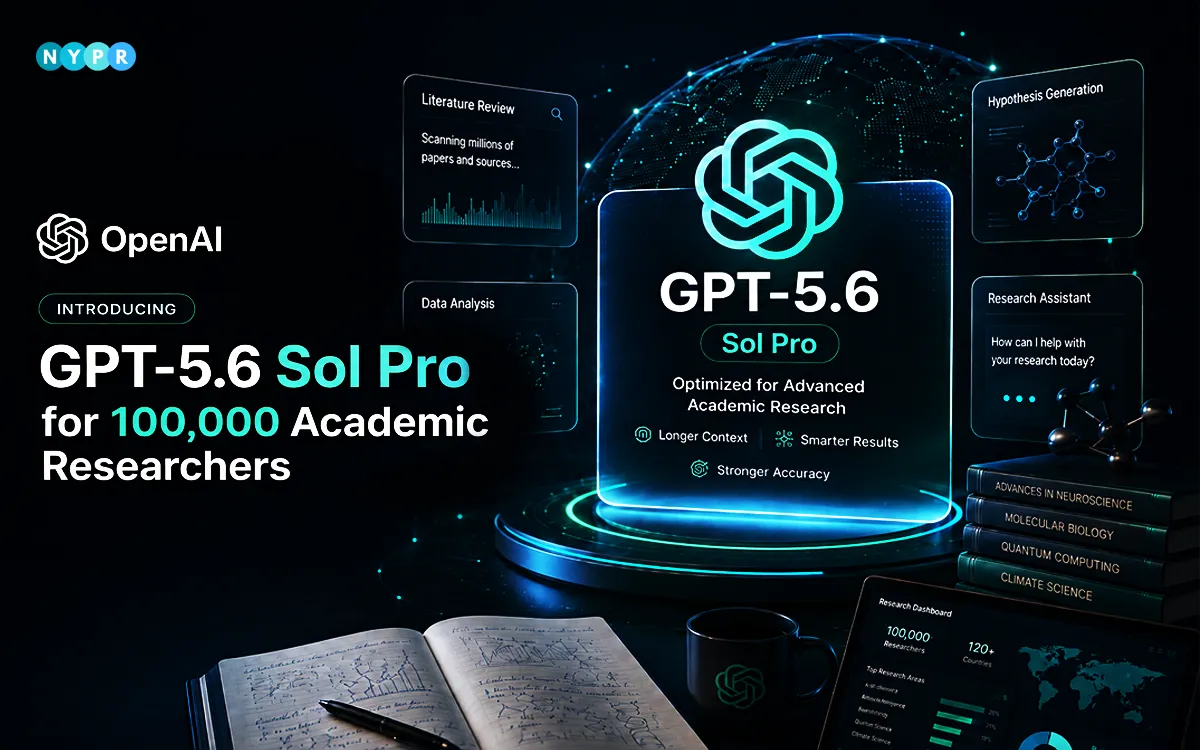
AI is no longer limited to chatbots and writing assistants. It is becoming part of everyday scientific research. On July 29, 2026, OpenAI announced ChatGPT for Academic Researchers. The new program will give 100,000 researchers at selected universities free access to frontier AI models by 2027. The goal is to help scientists spend less time on routine work and more time on research.
The rollout begins this summer with 10,000 researchers. The first participants come from the Institute for Advanced Study (IAS) and École normale supérieure (ENS). The program supports research in science, engineering, and mathematics. OpenAI says AI will assist with research tasks. Scientists will continue to make the final research decisions.
Who Benefits From OpenAI’s ChatGPT for Academic Researchers?
- Scientists can reduce time spent reviewing papers, organizing data, and writing research code.
- Researchers receive free access to GPT-5.6 Sol Pro and other frontier AI models.
- Research teams can collaborate more easily by inviting up to four colleagues from the same institution.
- Universities receive secure workspaces where research data is not used to train OpenAI’s models by default.
- Early-career researchers can prepare grant proposals, review studies, and draft manuscripts more efficiently.
The launch reflects a broader trend in higher education. Universities are using AI in more research projects. It helps analyze large datasets and review scientific literature. Many researchers also use it to support software development. Even so, human oversight remains important. Researchers continue to stress transparency and research integrity.
Unlike a standard AI subscription, this program is built for academic research. Researchers receive GPT-5.6 Sol Pro, ChatGPT Work, and Codex. They also get higher usage limits and larger context windows. The platform includes deep research tools and more than 75 life science skills. These features support genetics, genomics, sequencing, protein modeling, and drug discovery.
One of the biggest additions is GPT-5.6 Sol Pro. The model is designed to solve complex scientific and mathematical problems. For example, a biomedical researcher studying cancer may need to review hundreds of research papers. AI can quickly identify the most relevant ones. The researcher can then focus on planning the experiment. An engineering team could use Codex to debug simulation code. A mathematician could also test different approaches to a proof. They can then independently check and verify every result. AI speeds up the process, but researchers still verify every conclusion.
OpenAI says around 1.3 million people already use ChatGPT each week for advanced science and mathematics. Together, they generate about 8.4 million messages. OpenAI pointed to real-world research projects to show how AI is already being used. One team used it to develop fusion-energy software, while another applied it to mathematical research. In both cases, researchers checked and validated the final results themselves. This highlights AI’s growing role as a research assistant rather than just a productivity tool.
The program offers more than advanced AI models. The program includes training for researchers. It also offers technical support. Participants can connect with other researchers, share ideas, and discuss practical experiences. OpenAI says this feedback will help improve future models and better support scientific work.
The initiative is part of OpenAI’s commitment of more than $250 million to external scientific research through 2027. The investment also supports the NextGenAI initiative. It also funds collaborations with the U.S. Department of Energy’s Genesis Mission. Together, these efforts aim to advance scientific research. Applications are now open for eligible researchers at qualifying academic institutions.
AI is becoming a regular part of research. Universities and laboratories are adopting it for more tasks every year. As that happens, access to advanced AI tools is becoming more important. ChatGPT for Academic Researchers aims to remove cost barriers for eligible institutions. It also helps scientists spend less time on routine work. That gives them more time for experiments, analysis, and discoveries. If the program expands as planned, more researchers could gain access to frontier AI models. That could help speed up scientific research across different fields.
Author’s Note:
The New York press release sees OpenAI’s latest program as an important step for academic research. It could reduce routine work for researchers. That gives them more time to focus on experiments, discoveries, and solving complex scientific problems.













Leave a comment