

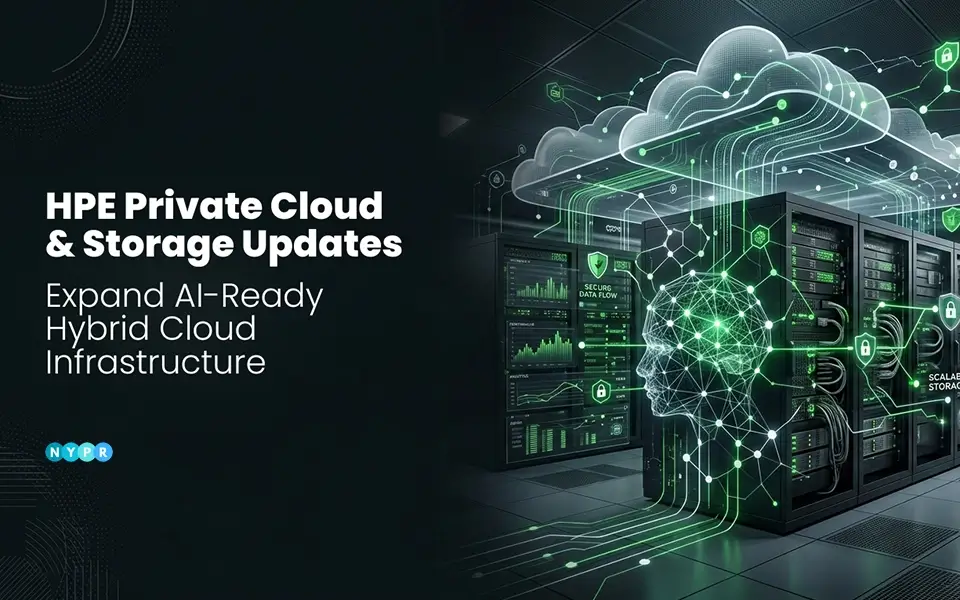
Enterprises are increasingly modernizing infrastructure as AI adoption grows across industries. Rising virtualization costs, expanding cloud-native workloads, and growing cybersecurity risks are pushing organizations to rethink how they manage data, applications, and operations.
Against that backdrop, Hewlett Packard Enterprise announced major HPE private cloud & storage updates designed to simplify hybrid cloud infrastructure and improve AI data readiness. The updates expand the company’s HPE GreenLake portfolio across private cloud, storage, data protection, and orchestration services.
The broader goal is to help enterprises manage traditional applications alongside modern HPE AI workloads through a unified operational model. As enterprise AI adoption accelerates, businesses are increasingly prioritizing scalable AI infrastructure, cyber resilience, and simplified multicloud operations rather than relying on fragmented infrastructure tools.
HPE GreenLake Expands Unified Hybrid Cloud Infrastructure
HPE’s latest GreenLake expansion focuses on combining private cloud AI, storage, and protection services into a more unified enterprise platform.
According to the company, enterprises modernizing for AI often face migration complexity, operational fragmentation, and rising infrastructure management costs. Businesses are also trying to support both legacy virtual machines and cloud-native workloads without creating additional operational overhead.
Fidelma Russo, EVP & GM of Hybrid Cloud and CTO at HPE, addressed those pressures directly:
Enterprises are rapidly modernizing for AI and cloud-native runtimes, and this transformation is placing new demands on how environments are managed, protected, and scaled. With these innovations, we’re helping organizations adopt a unified operating model that brings together private cloud, data, and protection, simplifies migration from legacy platforms, strengthens resilience, and delivers superior TCO to operate at scale.
The announcement reflects a broader shift happening across the hybrid cloud infrastructure market. Infrastructure vendors are increasingly competing around unified operations, AI-ready infrastructure, and simplified virtualization management rather than standalone hardware systems.
HPE Fourth-Generation Private Cloud Adds Unified VM and Kubernetes Management
HPE said its private cloud platform has now entered its fourth generation, with new capabilities designed to manage both virtual machines and Kubernetes containers within a single environment.
The platform allows enterprises to independently scale workloads depending on application needs, which becomes increasingly important as AI infrastructure modernization creates higher performance demands.
Existing HPE Private Cloud Business Edition customers can upgrade without replacing existing infrastructure. That may help organizations reduce migration costs and operational disruption during modernization projects.
A major part of the update involves HPE Morpheus Software, which provides hybrid and multicloud orchestration, migration, automation, and management tools.
HPE says the platform is designed to support:
- Unified infrastructure
- Unified operations
- Unified data management
- Reduced operational complexity
- Lower infrastructure risk
The systems are built on HPE ProLiant Compute Gen12 infrastructure, which HPE says improves performance per watt and workload consolidation.
Migration and cyber recovery capabilities were also expanded.
Zerto technology now supports live migration from VMware environments alongside continuous data protection and ultra-fast recovery from cyber incidents.
HPE also expanded integrations with Veeam Software, including agentless image backups, changed block tracking, cross-platform recovery, and data mobility support. StoreOnce integration adds real-time replication and near-zero RPO/RTO recovery support.
Why HPE Private Cloud & Storage Updates Matter for Enterprise AI?
Infrastructure consolidation is becoming a major priority for enterprise IT teams, and HPE Private Cloud & Storage Updates are part of that broader shift toward unified operations.
Organizations increasingly want platforms capable of managing virtualization, containers, AI workloads, and cyber recovery together instead of maintaining disconnected systems.
1. HPE SimpliVity Targets Edge and Distributed Infrastructure
HPE also introduced updates for HPE SimpliVity aimed at edge deployments and distributed IT operations.
The platform now supports HPE Morpheus VM Essentials and integrates with HPE StoreOnce Gen5 systems to improve resilience and backup consistency across multiple locations.
Edge infrastructure has become increasingly important as businesses process larger amounts of operational data outside centralized data centers. Retail stores, stadiums, manufacturing facilities, and remote offices often require localized infrastructure with centralized management.
Native StoreOnce integration is designed to provide secure and space-efficient backups while maintaining operational consistency for virtualized workloads.
2. HPE Alletra Storage Updates Focus on AI Workloads
Storage infrastructure was another major focus area in the announcement as enterprises continue building AI-ready infrastructure.
HPE Alletra Storage MP X10000 now adds native file storage alongside existing object storage support, creating a unified platform for enterprise AI and analytics environments.
The platform can scale up to 16 nodes and support 23PB of raw capacity. HPE also announced a 100% data availability guarantee.
Additional upgrades include RDMA-enabled file storage and S3 over RDMA support to improve throughput for AI training, inference, and KV cache workloads.
HPE also introduced a Data Protection Accelerator Node capable of backup ingest performance reaching up to 2.5PB per hour.
For enterprises building private cloud AI environments, storage throughput is becoming just as important as compute performance because AI systems rely heavily on the rapid movement of large datasets.
HPE also updated HPE Alletra Storage MP B10000 with autonomous capabilities powered by real-time agentic AI.
The platform now includes:
- Autonomous issue detection and resolution
- A 5:1 data reduction guarantee
- Lower storage cost per TB
- 50% more performance
- Dual-node fault tolerance
These upgrades are aimed at enterprises handling mission-critical workloads where downtime tolerance continues to shrink.
AI-Era Data Management and Cyber Resilience
Beyond infrastructure updates, HPE also introduced enhancements to its enterprise data management and cyber resilience offerings.
HPE Data Fabric Software now includes policy-based data placement and movement tools designed to simplify AI workload preparation.
The platform also adds a conversational AI assistant that provides natural language access to data environments alongside automated reporting, metadata visibility, and data lineage tracking.
Support for Apache Polaris was also added to strengthen governance and compliance capabilities.
At the same time, HPE expanded Zerto capabilities with an AI-powered data protection assistant and deeper integration with Microsoft Defender services.
The updates are intended to improve real-time threat visibility, orchestrated recovery, and faster cyber recovery capabilities.
Cyber resilience is becoming increasingly important because outages or ransomware incidents can now affect AI systems, analytics platforms, and operational applications simultaneously.
Enterprise Adoption Trends and Competition in Hybrid Cloud Infrastructure
HPE highlighted the Dallas Cowboys as an example of technology-driven operations requiring flexibility, resilience, and real-time fan engagement inside AT&T Stadium.
The company also emphasized its partnership with Veeam Software around data protection and infrastructure modernization.
HPE’s broader strategy arrives as vendors including Dell Technologies, Nutanix, and VMware continue expanding AI-focused hybrid cloud offerings.
Across the industry, vendors are increasingly competing around unified operations, scalable AI infrastructure, and simplified virtualization management.
Release Timeline for HPE Private Cloud and Storage Enhancements
The latest HPE Private Cloud & Storage Updates will roll out in phases across 2026, with several core integrations and private cloud systems already available.
Additional capabilities tied to AI-ready storage, unified VM and container management, and advanced cyber resilience tools are expected to arrive through Q2 and Q3 2026. The staggered rollout reflects the growing enterprise demand for scalable hybrid cloud infrastructure and operational flexibility as organizations continue modernizing for AI workloads.
1. Available Now
- Fourth-generation HPE Private Cloud systems
- StoreOnce integrations
- HPE Zerto integrations
- Veeam integrations
- HPE Data Fabric Software updates
2. Q2 2026
- HPE Alletra Storage MP X10000 file storage
- HPE Zerto enhancements
3. Q3 2026
- Unified VM and container management
- SimpliVity StoreOnce Gen5 integrations
- X10000 16-node scale-out support
- RDMA file support
- New Alletra Storage MP B10000 release
The Next Phase of Enterprise AI Infrastructure Modernization
Despite growing demand for AI-ready infrastructure, enterprises may still face migration complexity, operational retraining requirements, and long-term cost concerns when modernizing legacy systems.
Still, the broader direction of the enterprise infrastructure market is becoming clearer. Businesses increasingly want unified platforms capable of supporting virtualization, cloud-native workloads, cyber resilience, and AI operations together.
HPE’s latest GreenLake expansion reflects that industry-wide shift. Rather than focusing only on hardware performance, the company is positioning HPE GreenLake as a unified enterprise platform built around operational simplicity, resilience, and long-term AI readiness.









Leave a comment