

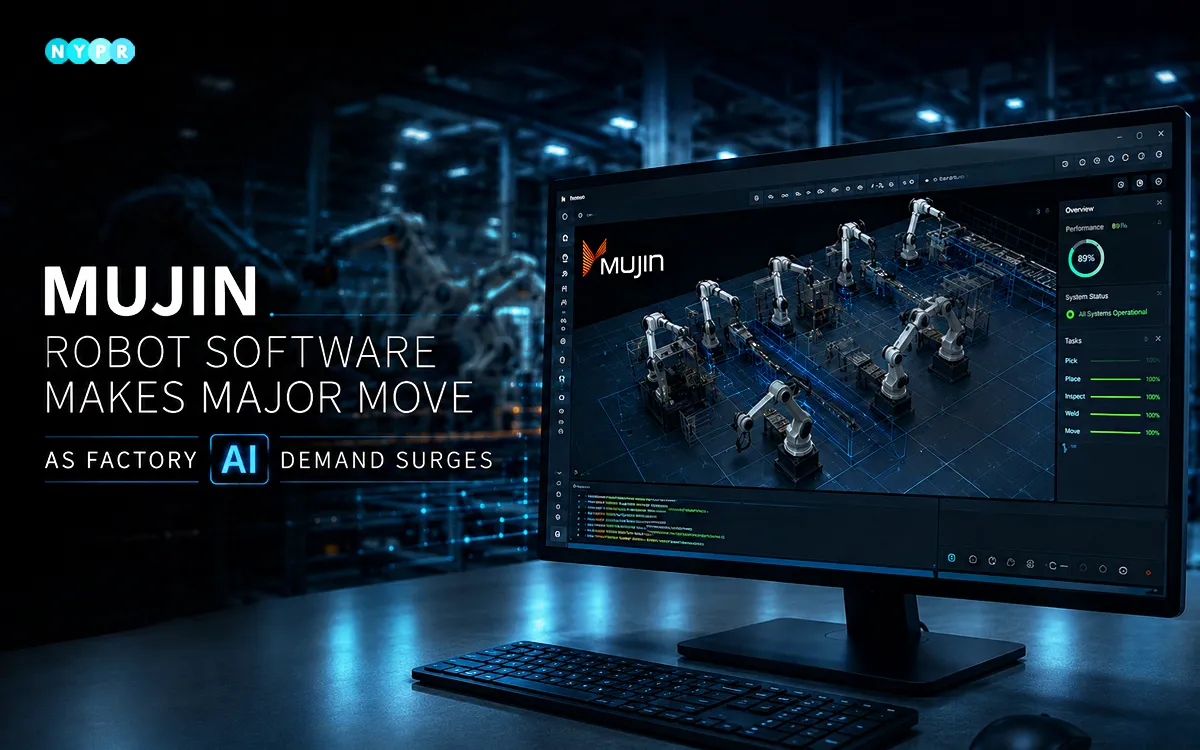
Mujin robot software is gaining momentum as manufacturers and logistics operators accelerate investment in warehouse automation and factory AI, placing the Japanese robotics company on a path toward a possible public listing by 2030.
The Tokyo-based startup is raising an extension round to its $233 million Series D funding, completed in December.Co-founder and CEO Issei Takino said the new round values Mujin at more than $1 billion and should provide enough capital to support the business until an initial public offering. He also expects the company to reach break-even before it goes public.
Backed by the Qatar Investment Authority, Mujin has become one of the more closely watched names in industrial robotics software. The company generates most of its revenue from Japan and the United States and is targeting a 50% increase in U.S. sales this year.
Founded in 2011 by Takino and Bulgaria-born robotics engineer Rosen Diankov, Mujin was built to solve a long-standing problem in robotics: the need to manually program every machine movement. That process has often slowed automation projects and made them harder to scale.
At the center of the offering is Mujin software, a control system that helps robots make decisions in real time. Instead of relying only on fixed instructions, the software combines artificial intelligence, motion planning, and digital twin capabilities to calculate safe, efficient actions as conditions change.
The company’s warehouse robotics platform supports a range of material-handling tasks:
- Loading and unloading goods
- Sorting and stacking products
- Managing pallets, carts, and containers
- Coordinating multiple robots through one system
Its digital twin technology creates a live virtual replica of equipment and workflows. By continuously analyzing sensor data, the system predicts movement, reduces collision risk, and helps robots adapt on the fly. That makes it useful in warehouses and factories where product types, layouts, and traffic patterns can change quickly.
The technology traces its roots to OpenRAVE, a robotic motion-planning framework developed by Diankov. That foundation allows robots to calculate collision-free paths dynamically rather than depend entirely on preset commands.
Mujin’s technology is already used by major organizations, including Toyota Motor Corp., Fast Retailing Co., Denso Corp., Mitsubishi Electric Corp., Fanuc Corp., and Yaskawa Electric Corp. Its compatibility across different robot brands has helped it gain traction with large industrial customers looking for flexible automation.
In China, Starbucks facilities use robots powered by Mujin software to move coffee bean shipments from pallets onto conveyor belts, reducing manual handling and helping streamline fulfillment workflows.
The company said sales doubled in its last fiscal year and expects revenue to double again this year as more businesses adopt smarter factory systems. Takino said several market forces are driving that demand, including labor shortages, rising operating costs, and pressure to improve supply chain resilience.
Key growth drivers include:
- Hard-to-fill labor-intensive roles
- Higher costs in factories and distribution centers
- Faster adoption of AI-powered industrial systems
- Demand for more efficient logistics operations
Looking ahead, Mujin remains open to a New York listing if its valuation exceeds $3 billion, though a Tokyo IPO is still possible. Beyond the public-market plan, the company wants to become a common operating system for robots worldwide.
“We want Mujin to be the company powering the world’s robots,” Takino said, underscoring the firm’s ambition to become the software layer behind the next wave of factory and warehouse automation.
Author’s Note
Mujin’s expansion shows how industrial software is becoming just as important as robotics hardware. For manufacturers and logistics operators, the real shift is not only about adding machines, but about using smarter systems that help those machines work safely, adapt quickly, and scale across complex operations.
















Leave a comment