

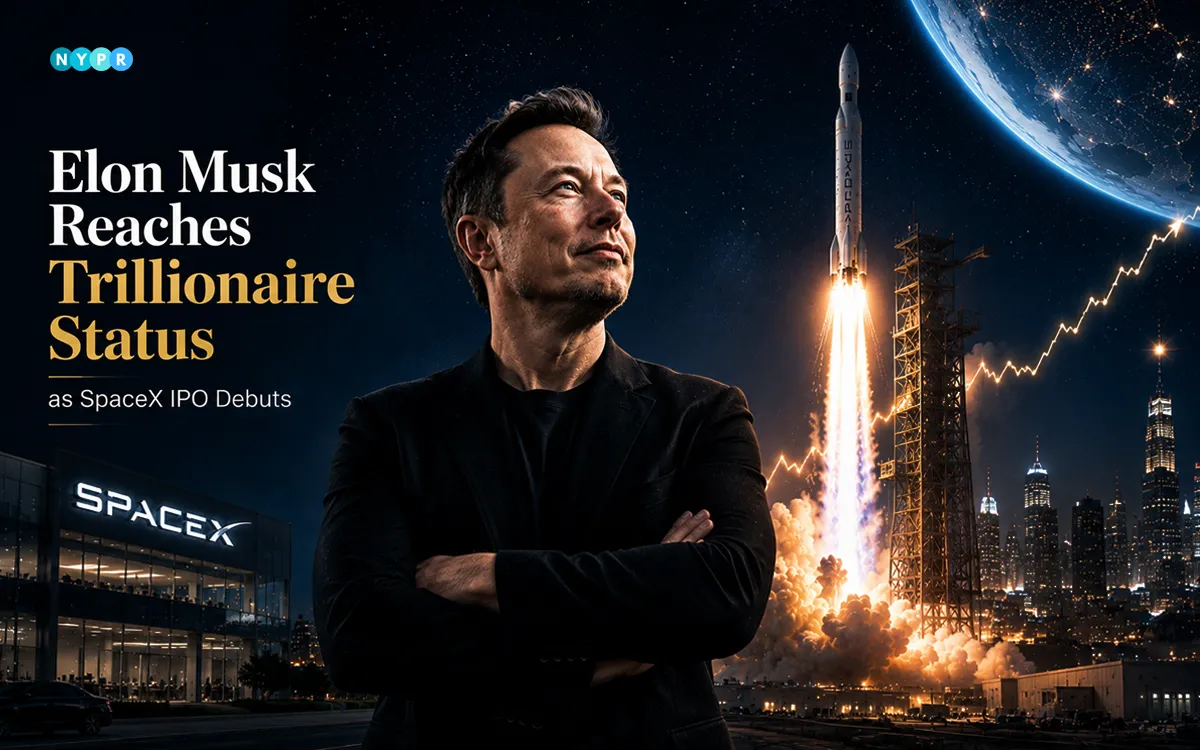
The highly anticipated SpaceX IPO is set to make history after Elon Musk’s company priced its public offering at $135 a share, raising about $75 billion and valuing the business at $1.77 trillion. The stock is expected to begin trading on Nasdaq on Friday, making it the largest IPO in U.S. history and one of the biggest market debuts ever.
According to SpaceX’s SEC filing, the offering includes 555,555,555 Class A shares, all primary, with a total size of $74,999,999,925. The filing also lists the trade date as June 12, 2026, and the closing date as June 15, 2026.
The SpaceX IPO ahead of its Nasdaq debut gives public investors their first chance to buy into the 24-year-old company. But this is not a simple aerospace story. SpaceX is now being pitched as a space, satellite, and AI business, with Starlink carrying most of the revenue and xAI adding another layer to Musk’s long-term growth thesis. Reuters reported that the company’s fixed $135 price also broke from the usual Wall Street pricing process.
Key Takeaways:
- SpaceX raised about $75 billion in the offering.
- The company is valued at roughly $1.77 trillion.
- Musk retains 82% of voting power after the IPO.
- 30% of shares were set aside for retail buyers.
Financial results show why the market is treating this as both a growth story and a bet on execution. SpaceX said revenue rose 15% in the first quarter to $4.69 billion, while full-year 2025 revenue increased 33% to $18.67 billion. Even so, the company posted a net loss of $4.28 billion in the latest quarter and warned that profitability may not arrive in the future.
Starlink remains the main revenue engine and the only profitable part of the business. At the same time, SpaceX is spending aggressively on the next phase of growth. Its first-quarter capital expenditures reached $10.1 billion, including $7.7 billion tied to AI-related investment.
The Elon Musk SpaceX IPO also has major implications for Musk’s wealth and control. Reports say that the stake is valued at about $866.5 billion, with Tesla holdings worth roughly $320 billion on top of that. He will keep more than 82% of voting power, preserving a level of founder control that is rare even among mega-cap public companies.
Analysts are already weighing in. Oppenheimer launched coverage with an outperform rating and a $190 target, while New Street Research set a $165 target. Both see SpaceX’s integrated model, engineering scale, and AI exposure as major strengths. Still, SpaceX’s largest IPO in history is being watched as a test of whether public markets are willing to reward ambition, heavy spending, and long-horizon technology bets at this scale.
Author’s Note
The SpaceX IPO is more than a record-setting listing. It shows how investors are valuing companies that combine connectivity, AI, and infrastructure under one roof, even when profits are still a work in progress.

















Leave a comment