

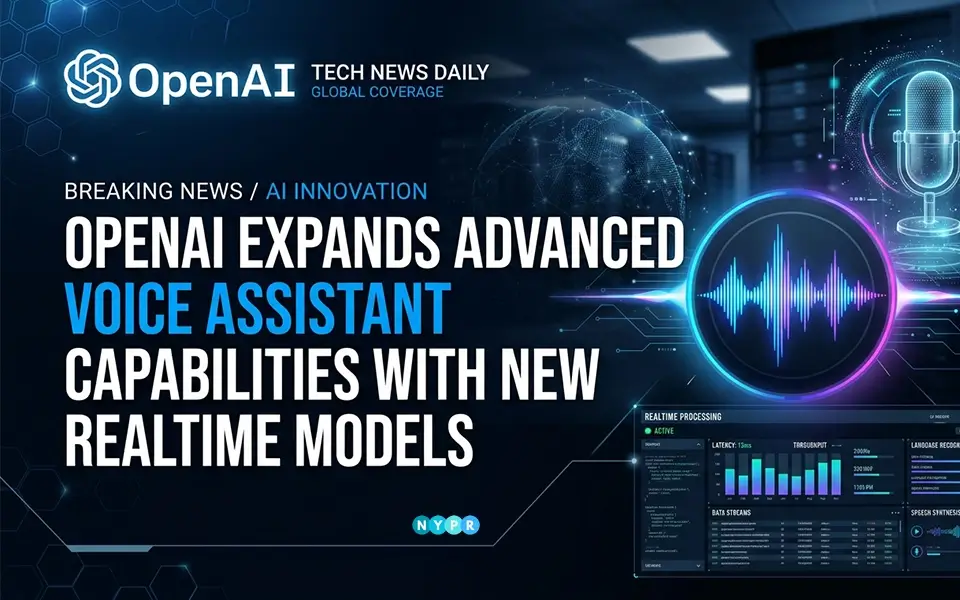
Voice AI is starting to move beyond simple commands and scripted responses. On May 7, 2026, OpenAI introduced a new set of realtime audio models designed to help developers build more natural software experiences through speech. The announcement focuses on making the modern advanced voice assistant more conversational, responsive, and useful in everyday situations.
The company says the new models can listen, reason, translate languages, transcribe speech, and even trigger actions while conversations are happening. That matters because more people are interacting with software while driving, traveling, working remotely, or multitasking across devices.
Developers and businesses are paying attention because realtime voice tools are quickly becoming part of customer support systems, productivity software, travel services, and multilingual communication platforms. Industry analysts also expect conversational AI adoption to continue growing as companies invest more heavily in voice-driven customer experiences.
Inside OpenAI’s Latest Voice AI Announcement
OpenAI introduced three new realtime audio models through its API platform:
- GPT-Realtime-2
- GPT-Realtime-Translate
- GPT-Realtime-Whisper
The models are designed to help developers create voice experiences that feel less mechanical and more responsive during live conversations. Instead of waiting for long pauses or rigid prompts, these systems are built to react naturally while conversations continue in real time. According to the announcement, the models can:
- Listen to spoken language.
- Reason through requests
- Translate conversations
- Transcribe speech
- Trigger actions in realtime
The release reflects a broader shift happening across the software industry. Voice interfaces are becoming increasingly common as people interact with apps while driving, walking, traveling, or speaking across different languages.
As Openai’s advanced voice mode continues expanding, developers are also building more natural speech-based experiences across customer support, productivity, and multilingual communication tools. Rather than typing commands into software, users are beginning to expect systems that can respond through speech in a more fluid way.
Advanced Voice Assistant Features Driving the New Models
The new realtime voice models are built to make conversations with AI feel faster, smoother, and more practical. OpenAI is focusing on tools that can understand speech naturally, translate languages live, manage interruptions, and support realtime actions across apps and services.
1. GPT-Realtime-2
GPT-Realtime-2 is positioned as the most capable model in the new lineup. OpenAI says it delivers GPT-5-class reasoning abilities while supporting natural voice conversations. The system is designed to handle more complicated spoken requests without losing context mid-conversation. That includes situations where users interrupt, change direction, or ask follow-up questions rapidly.
Several upgrades stand out:
- Parallel tool calling
- Better interruption handling
- Improved recovery behavior
- Tool transparency during tasks
- More controllable tone and delivery
- Stronger understanding of specialized terminology
The model also supports a 128K context window, allowing it to maintain longer conversations and process larger amounts of information during a session.
Developers can adjust reasoning intensity through different settings:
- minimal
- low
- medium
- high
- xhigh
OpenAI also shared benchmark improvements tied to audio performance.
The company says GPT-Realtime-2 scored:
- 15.2% higher on Big Bench Audio
- 13.8% higher on Audio MultiChallenge
Those improvements suggest the model is better at understanding spoken instructions, accents, interruptions, and multi-step requests in live environments.
2. GPT-Realtime-Translate
GPT-Realtime-Translate focuses on live multilingual communication. One of the biggest additions is multilingual support, with more than 70 input languages and 13 output languages available for translated voice conversations in real time.
The system can also generate live transcriptions while translation is happening. The goal is to reduce delays that normally happen during multilingual conversations. Instead of pausing between sentences, users can speak naturally while the system translates continuously.
Possible use cases include:
- Customer support centers
- International travel services
- Education platforms
- Cross-border communication
- Creator and streaming platforms
As global software products continue expanding into multiple regions, realtime translation is becoming increasingly valuable for businesses trying to serve international users without major language barriers.
3. GPT-Realtime-Whisper
GPT-Realtime-Whisper is designed for streaming speech-to-text transcription with lower latency. The model can generate live captions and real-time transcriptions during meetings, calls, presentations, or customer interactions. Businesses can also integrate the system into workflows that depend on spoken information being converted into text instantly.
Potential use cases include:
- Healthcare documentation
- Recruiting interviews
- Sales conversations
- Customer support systems
- Live events and broadcasts
Realtime transcription tools are already widely used, but OpenAI appears focused on making speech recognition faster and more reliable during active conversations.
Where Realtime Voice AI Is Being Used
Realtime voice AI is starting to appear across a wider range of industries and software experiences. Travel companies are exploring AI-powered booking assistants that can help users search flights, modify reservations, or translate conversations during international trips. Customer support platforms are testing multilingual voice systems that can respond to users in real time without requiring human translators.
Businesses are also experimenting with smart meeting summaries, AI sales conversations, healthcare transcription tools, and live captioning systems for digital events. As voice interface technology improves, many companies are beginning to treat voice interaction as part of the core software experience rather than a separate assistant feature.
How Realtime AI Moves Beyond Traditional Voice Assistant?
Traditional voice assistant were mostly designed for short interactions, such as checking the weather, setting alarms, or answering basic questions. The newer realtime AI systems introduced by OpenAI are built for more dynamic conversations.
They can process interruptions, maintain longer context windows, support advanced voice analytics, translate languages during live conversations, and trigger actions while users are speaking. That shift could make conversational AI feel less like a voice command system and more like an interactive software layer that works across apps and workflows.
Industries and Users Seeing the Biggest Impact
The rollout of realtime voice AI could impact businesses, developers, and everyday users in different ways. From customer support systems to productivity apps, the technology is opening new possibilities for how people interact with software through speech.
1. How Businesses May Use Realtime Voice AI?
Companies may use realtime voice AI to automate customer interactions, reduce support wait times, improve multilingual communication, and create hands-free software experiences.Industries like travel, telecom, healthcare, and retail are especially likely to experiment with these tools first.
2. How Developers Could Build With the New API?
Developers now have direct API access to realtime voice capabilities that previously required multiple separate systems for speech recognition, translation, reasoning, and transcription. That could simplify app development while reducing infrastructure complexity. Developers may also use the technology to build AI meeting assistants, multilingual support systems, voice commerce platforms, and conversational productivity tools.
3. How Users May Experience Smarter Voice AI?
Users may gradually experience more natural AI interactions inside apps, devices, support systems, and digital services. Instead of rigid voice assistant future systems may behave more like live conversational interfaces that can actually complete tasks during discussions.
Access, Rollout, and Pricing Details
OpenAI has made the new voice models available through its API platform, giving developers early access to realtime audio capabilities. The pricing structure varies depending on whether the focus is on reasoning, translation, or live transcription services.
1. Where the New Models Are Available?
OpenAI says the new models are available through the Realtime API. Developers can also test the systems in the Playground and integrate them using Codex tools and workflows.
2. Realtime Voice AI Pricing Breakdown
OpenAI shared the following pricing details:
A. GPT-Realtime-2
- $32 per 1M audio input tokens
- $0.40 cached input tokens
- $64 per 1M audio output tokens
B. GPT-Realtime-Translate
- $0.034 per minute
C. GPT-Realtime-Whisper
- $0.017 per minute
The pricing structure appears aimed at businesses and developers building large-scale voice applications rather than casual consumer use.
The Expanding Role of Realtime Voice AI
Realtime voice interfaces and advanced voice assistant technologies are likely to expand further across travel services, customer support platforms, productivity software, and multilingual communication tools. The biggest opportunity may come from systems that combine conversation with action-taking abilities.
Instead of only responding verbally, future voice interfaces may schedule appointments, retrieve information, update records, or manage workflows during live conversations. At the same time, reliability, latency, privacy concerns, and user trust will continue shaping adoption. The technology is improving quickly, but widespread integration into everyday software will still depend on how consistently these systems perform in real-world environments.
The Growing Shift Toward Voice-Driven AI
Realtime voice AI is starting to evolve beyond simple conversation tools into software interfaces that can understand context, manage tasks, and respond during live interactions. OpenAI’s latest API models reflect that larger shift happening across the industry. Rather than replacing traditional apps, voice systems are increasingly becoming another way people interact with software naturally while moving through daily life.












Leave a comment