

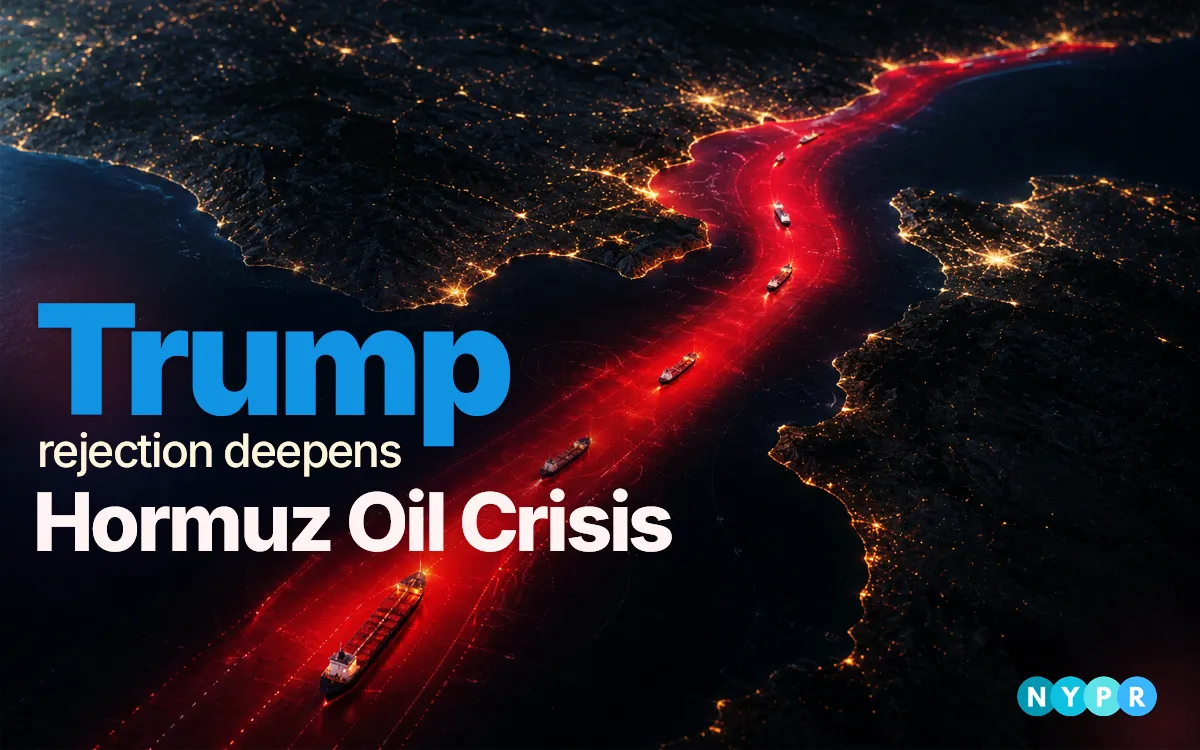
Global markets reacted sharply after U.S. President Donald Trump rejected Iran’s latest response to a U.S.-backed peace proposal, as oil prices surge amid a fresh crude oil jump and renewed fears over the Strait of Hormuz. The latest Hormuz Crisis has intensified concerns about disruptions to global oil supply, with traders reacting quickly to signs that the oil market could face prolonged shipping instability.
Brent crude climbed more than $4 a barrel after Trump dismissed Tehran’s demands as “TOTALLY UNACCEPTABLE,” raising doubts that negotiations would resume anytime soon.
The continued disruption has already rattled shipping firms, tanker operators, and energy traders worldwide. Analysts warn that if the Strait of Hormuz remains partially blocked, consumers could eventually face higher gasoline prices, rising transportation costs, and broader inflation pressure.
Before the conflict began on February 28, nearly one-fifth of the world’s oil and liquefied natural gas shipments moved through the narrow waterway every day.
Diplomatic Breakdown Sends Oil Higher
The latest crude oil jump followed reports that Washington had floated a proposal aimed at reopening diplomatic talks and securing an immediate halt to the fighting.
According to Iranian state TV and the semi-official Tasnim news agency, Tehran responded with a broader set of political and economic demands that extended well beyond a temporary ceasefire.
Iran’s response reportedly focused on ending fighting across multiple fronts in the region, particularly in Lebanon, where Israel continues military operations against Iran-backed Hezbollah militants.
Markets initially viewed the U.S. outreach as a possible step toward stabilizing the Strait of Hormuz and easing pressure on energy shipments. Instead, the exchange between Washington and Tehran reinforced fears that the standoff may continue for weeks.
That uncertainty immediately spilled into the global oil market.
Energy traders reacted aggressively as concerns grew that prolonged disruption in the Persian Gulf could tighten global oil supply and increase volatility across international fuel markets.
Trump Dismisses Tehran’s Conditions
Any early optimism surrounding diplomacy faded after Trump publicly rejected Iran’s response.
Posting on Truth Social, Trump wrote:
“I don’t like it, TOTALLY UNACCEPTABLE.”
The reaction signaled that Washington and Tehran remain far apart on the conditions needed to end the conflict.
Reports indicate that the U.S. proposal focused first on securing an immediate halt to the fighting before discussing broader issues such as Iran’s nuclear program and regional security concerns.
Iran, however, demanded wider guarantees before agreeing to any settlement.
The sharp rejection deepened fears that the 10-week-old conflict could continue without a clear diplomatic breakthrough.
For oil traders, the concern is straightforward. As long as shipping through the Strait of Hormuz remains heavily restricted, the risk of supply disruption stays elevated.
Strait of Hormuz Emerges as Global Energy Flashpoint
The Strait of Hormuz is one of the world’s most critical energy chokepoints.
Located between Iran and Oman, the narrow passage connects the Persian Gulf to global shipping routes. Before the war erupted in late February, roughly 20 million barrels of oil passed through the waterway every day, along with nearly one-fifth of global liquefied natural gas exports.
That makes the route essential to the stability of the global economy.
Major energy producers, including Saudi Arabia, Iraq, Kuwait, and the United Arab Emirates, rely heavily on Hormuz to export crude oil to Asia, Europe, and other international markets.
Even partial disruption can create immediate market anxiety.
Shipping insurers have already raised risk premiums for vessels entering the region, while several tanker operators are reportedly reducing traffic through the area until security conditions improve.
The longer the blockage continues, the greater the threat to the global oil supply and fuel price stability worldwide.
Why Do Oil Prices Rise When the Strait of Hormuz Is Disrupted?
Oil prices tend to rise quickly whenever tensions escalate around the Strait of Hormuz because the market reacts not only to actual shortages but also to the fear of future disruptions.
When tanker traffic slows or shipping companies reroute vessels, traders begin pricing in the possibility that fewer oil exports will reach global markets.
That uncertainty often pushes Brent crude and other oil benchmarks higher before physical shortages even appear.
The Strait of Hormuz matters because so much of the world’s energy trade depends on it. A major disruption can affect refinery operations, fuel inventories, shipping costs, airline expenses, and inflation levels across multiple economies at once.
This is why every geopolitical headline connected to the Hormuz crisis is moving markets so aggressively.
Tehran Pushes Broad Security and Oil Conditions
Iran’s reported response outlined several major conditions before any broader agreement could move forward.
According to state-linked media reports, Tehran demanded compensation for war-related damage and formal recognition of Iranian sovereignty over the Strait of Hormuz.
Iran also called for:
- an end to the U.S. naval blockade,
- guarantees against future attacks,
- sanctions relief,
- and the removal of restrictions on Iranian oil sales.
Taken together, the demands reflected Tehran’s effort to connect the immediate conflict with long-standing economic and security disputes involving Washington and its regional allies.
For the United States, accepting those conditions would likely face strong domestic and international resistance.
For the oil market, however, the bigger concern is that negotiations now appear increasingly complex rather than closer to resolution.
Oil Market Volatility Deepens Across Global Trade
The oil market has become extremely sensitive to every new development coming from Washington and Tehran.
Analyst Priyanka Sachdeva noted that energy traders are reacting sharply to geopolitical headlines because the conflict directly threatens one of the world’s most important oil transit corridors.
That explains why oil prices climbed so rapidly after Trump rejected Iran’s proposal.
Markets are responding not only to current shipping disruptions but also to fears that the conflict could expand further across the Middle East.
Investors are closely watching whether OPEC producers and other exporters may increase output elsewhere to offset losses tied to the Strait of Hormuz.
So far, uncertainty continues to dominate trading sentiment.
Rising Fuel Costs Add Pressure in Washington
Rising gasoline prices are becoming increasingly politically sensitive in the United States ahead of nationwide elections that could determine control of Congress.
Historically, spikes in fuel prices tend to affect consumer sentiment quickly because they directly impact household budgets, transportation costs, and inflation expectations.
That creates additional pressure on policymakers in Washington.
A prolonged Hormuz crisis could force the White House to balance its hard diplomatic position against growing economic concerns at home.
Consumers are already watching fuel prices closely, and any sustained crude oil jump could create wider inflation pressure across the U.S. economy.
Markets Brace for Prolonged Regional Uncertainty
Several outcomes remain possible in the coming weeks.
Diplomatic talks could eventually restart if both sides soften their positions or agree to a temporary arrangement focused solely on reopening shipping lanes.
Another possibility is a prolonged stalemate where limited tanker movement resumes under heavy military monitoring while broader political disputes remain unresolved.
The most concerning scenario for global markets would involve a wider regional escalation that damages additional oil infrastructure or spreads conflict beyond current fronts.
Until shipping conditions improve, the oil market is likely to remain vulnerable to every new headline emerging from Washington and Tehran.
Energy Markets Enter a New Phase of Instability
The latest rally shows how deeply geopolitics still shapes the modern energy economy.
A single diplomatic breakdown between Washington and Tehran was enough to trigger a sharp crude oil jump and renew fears about the stability of one of the world’s most important trade routes.
As long as uncertainty surrounds the Strait of Hormuz, governments, businesses, and consumers worldwide will remain exposed to sudden swings in energy prices and broader economic pressure.

















Leave a comment